



If you asked banking executives across the United States, Europe, and Asia-Pacific to rank themselves by transformation ambition, APAC institutions would likely score at or near the top, government-backed digital banking agendas, some of the world’s fastest-growing digital payment ecosystems, and a genuine willingness among regional banks to leapfrog legacy infrastructure rather than modernize it incrementally. So it is worth sitting with a specific finding from a recent cross-regional survey: among 348 senior banking decision-makers across the US, Europe, and Asia-Pacific, APAC institutions reported the highest exposure to new and non-financial risk of any of the three regions, 55%, compared with 46% in the US and 49% in Europe.
That gap is not evidence that APAC banks are pursuing riskier strategies than their global peers. It is evidence of something more specific and more actionable: execution moving fast against a risk surface that has not fully matured to match the pace.
Ambition and Risk Maturity Are Not the Same Curve
Every region in this research shows the same underlying pattern – strategic ambition converging across the industry while execution capability varies by institution and by market. APAC amplifies this pattern because the pace of change is faster than almost anywhere else. New digital-only banking licenses, rapid real-time payments adoption, and aggressive AI deployment timelines are all genuinely ahead of where most Western markets are on the same initiatives. That speed is a real strategic advantage. It also means the risk management, governance, and control frameworks that were built for a slower-moving industry are being asked to keep pace with a transformation cycle that, in several APAC markets, is running years ahead of the regulatory and risk-maturity curve that eventually needs to catch up to it.
This is a distinctly different execution challenge than the ones showing up in North America or Europe. US institutions are grappling with urgency outpacing delivery capacity. European institutions are grappling with regulatory scrutiny intensifying around execution itself. APAC institutions are grappling with something closer to velocity outpacing risk maturity, moving fast enough that the non-financial risk categories a transformation program touches (model risk, third-party risk, operational resilience, data governance) have not yet been fully mapped and controlled for the new pace of change.
Why “New and Non-Financial Risk” Is the Right Category to Watch
Traditional banking risk management was built primarily around credit, market, and liquidity risk, categories with decades of actuarial and regulatory precedent behind them. New and non-financial risk is a broader, newer category that includes model risk from AI systems, third-party and vendor risk from an increasingly complex technology supply chain, operational resilience risk from interconnected digital infrastructure, and data governance risk from the volume and velocity of data now flowing through real-time systems. These are exactly the risk categories a fast-moving AI-first transformation program generates the most of and exactly the categories where control frameworks, across the industry, are least mature.
APAC institutions reporting the highest exposure to this specific risk category is a direct, logical consequence of leading the pace of change. It is not a sign that APAC banks are executing worse than their global peers. If anything, it may reflect institutions further along in deployment than peers elsewhere, encountering risk categories in production that slower-moving competitors have not reached yet.
What This Means for Program Design in the Region
The practical implication for APAC executives is not to slow down regional competitive dynamics and government-backed digital agendas make that an unrealistic recommendation for most institutions. The more useful discipline is to treat non-financial risk maturity as a workstream that has to keep pace with delivery velocity, rather than one that catches up afterward. That means building model risk governance, third-party risk assessment, and data governance capability in parallel with the transformation program itself, resourced and reviewed on the same cadence as the technology delivery, not bolted on once a capability is already in production and a gap has already surfaced.
Institutions that get this sequencing right are able to sustain the region’s characteristic pace of transformation without accumulating the kind of risk debt that eventually forces a slowdown either through an internal control failure or, increasingly, through regulatory intervention as APAC supervisors, following the pattern already visible in Europe and the US, begin applying more active scrutiny to transformation execution itself.
The Broader Signal
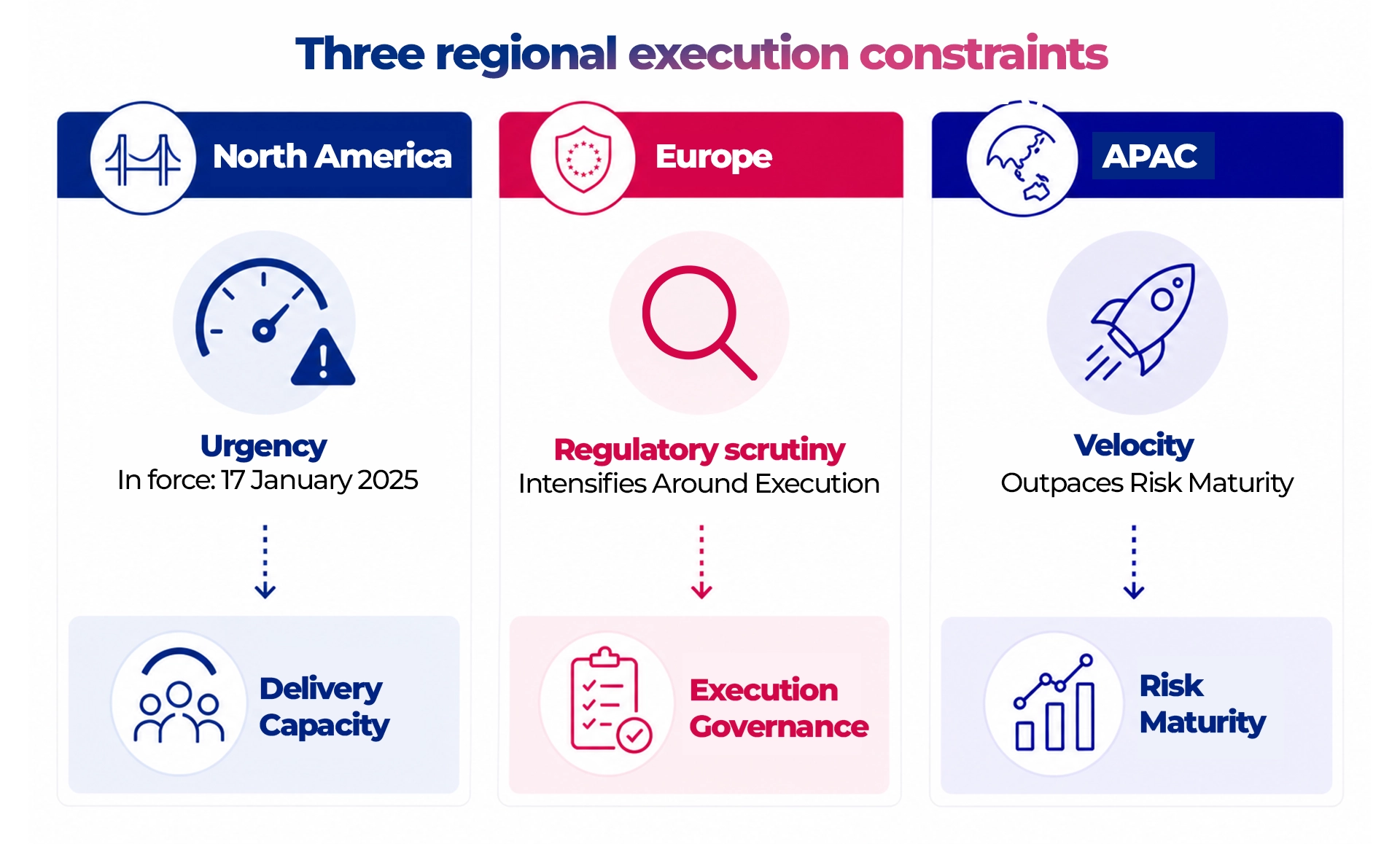
Read alongside the regional data from North America, Europe, and the Middle East, the APAC finding completes a consistent picture: every region is running into essentially the same execution constraint, expressed through whatever pressure is most acute locally. In the US, it is delivery capacity lagging urgency. In Europe, it is regulatory scrutiny of execution intensifying. In APAC, it is risk maturity lagging velocity. None of these are strategy problems. All of them are solvable with the same underlying discipline: building the governance, capability, and risk infrastructure a transformation program needs at the same pace as the transformation itself, rather than treating it as a workstream that can catch up later.
Related reading
- Why Most Banking Transformations Fail at Execution (pillar guide)
- The Middle East Paradox: Why Unlimited Capital Still Cannot Buy Execution Speed.
Sources
FAQ
1. Does higher reported risk exposure mean APAC banks are executing worse than US or European peers?
No. It more likely reflects institutions further along in deployment than peers elsewhere, encountering non-financial risk categories in live production that slower-moving competitors have not reached yet.
2. What should APAC executive teams do differently given this finding?
Treat non-financial risk maturity, model risk governance, third-party risk assessment, data governance, as a workstream resourced and reviewed on the same cadence as the technology delivery itself, rather than a gap addressed after it surfaces in production.
3. How does the APAC execution constraint differ from the US and European patterns?
US institutions are grappling with urgency outpacing delivery capacity. European and UK institutions are grappling with regulatory scrutiny intensifying around execution itself. APAC institutions are grappling with velocity outpacing risk maturity, the control frameworks have not yet caught up with the pace of change.