

AI-led automation has proved its value across banking. Customer service teams resolve enquiries faster, lending operations process applications more efficiently, fraud teams identify suspicious activity sooner, and payments move with less manual intervention. Yet the most common measure of progress remains narrow: how much of the process has been automated.
Automation rate tells a bank how many decisions are being handled by machines. It does not tell leaders whether those decisions are correct, consistent, explainable, or defensible. As AI in banking moves from pilots into high-volume operations, that distinction becomes critical. A bank can report an impressive automation rate while accumulating decisions it cannot reconstruct, validate, or justify when challenged.
Efficiency Can Hide Accumulated Risk
Traditional automation worked through fixed rules. When a rule produced an outcome, the rule itself formed part of the explanation. AI-led automation is different. It assembles context from structured and unstructured information, applies a particular model version, and produces a decision specific to one customer, transaction, alert, or payment instruction.
That context-specific capability makes AI more powerful. It also creates a new accountability requirement. The bank must be able to show what information the system used, whether it was current and complete, which model produced the result, and why the decision was reasonable for that case.
Without this infrastructure, banking operations automation can scale the wrong outcome as efficiently as the right one. Stale account data can distort a credit decision. An unnoticed change in an upstream transaction feed can weaken fraud detection. A payment model can make a technically sound assessment using a counterparty profile that is already out of date.
The efficiency remains visible, while the risk emerges later through complaints, audit findings, regulatory examination, or retrospective correction. The whitepaper notes that remediation after an automated process fails can cost significantly more than building the necessary validation and governance infrastructure at the outset.
From Automation Rate to Defensible Automation Rate
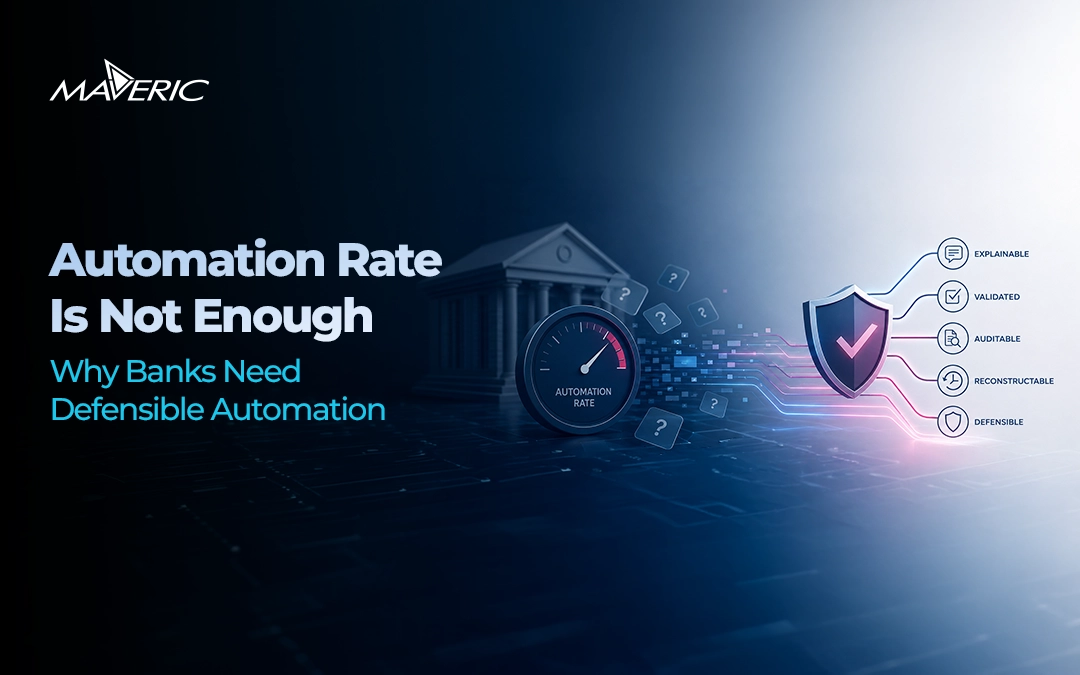
Banks therefore need a more meaningful measure: defensible automation rate.
This measures the proportion of automated decisions that can be explained, validated, audited, and reconstructed under the obligations that apply to them. It asks a harder question than “Was this automated?” It asks, “Can the bank account for what the automation did?”
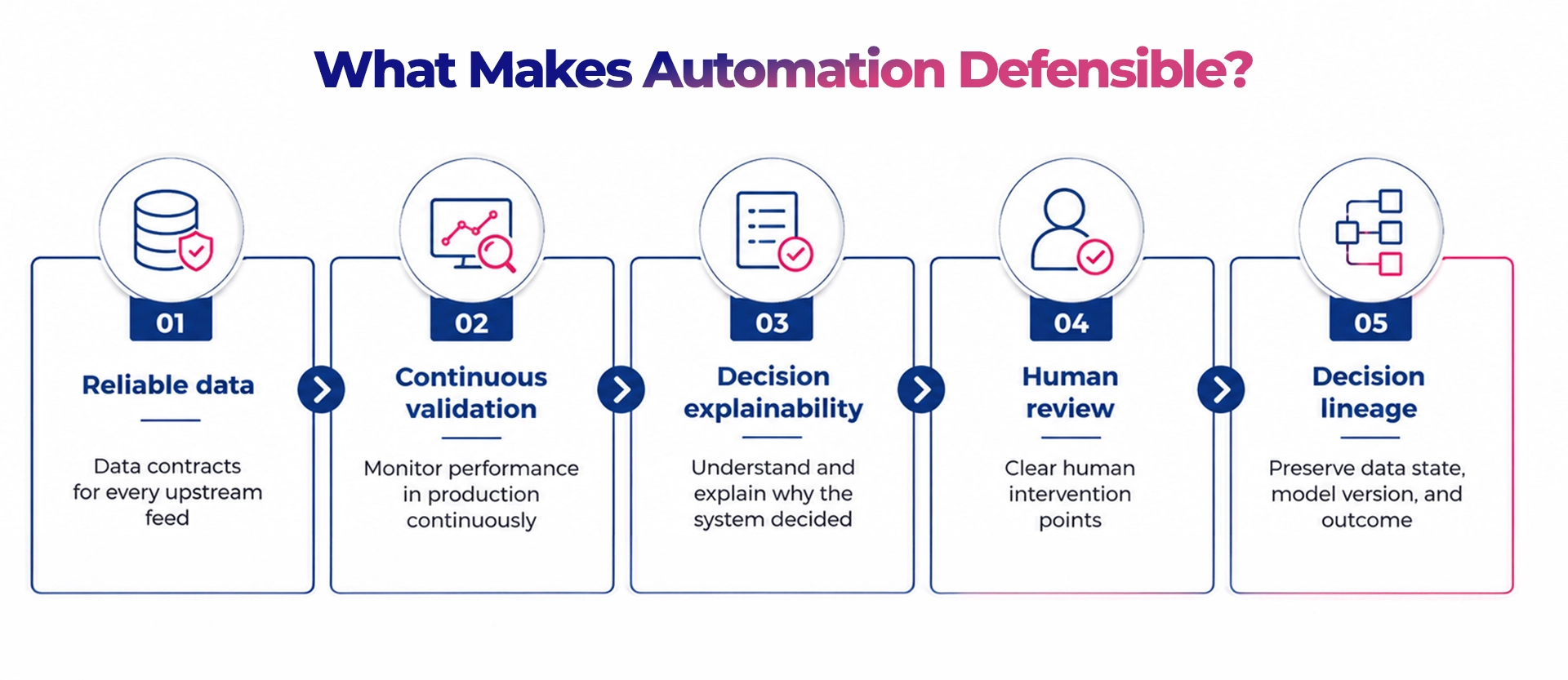
A high defensible automation rate requires more than model accuracy. It depends on data contracts for every upstream feed, continuous validation in production, decision-level explainability, clear human-review points, and lineage that preserves the data state and model version used at the time of each decision.
This is the practical foundation of trusted AI in banking. Trust is not created by a governance document written after deployment. It is engineered into the operating system of automation before scale increases the consequences of failure.
The metric also changes management behaviour. Teams are no longer rewarded merely for removing manual steps. They must demonstrate that the automated process remains reliable across customer segments, transaction types, entity groups, and changing data conditions.
What CIOs Should Do Differently
The CIO’s role is not to slow automation. It is to ensure that efficiency and accountability scale together.
The first step is to inventory automated decisioning across customer service, lending, fraud, payments, and back-office operations, including tools adopted outside formal approval processes. For each process, the bank should identify the data consumed, the obligation the output fulfils, the human-review touchpoints, and the lineage available.
Next, leaders should prioritise continuous validation for the highest-volume and highest-consequence models. Fraud, AML, credit decisioning, and payments are natural starting points because their performance depends heavily on data freshness, consistency, and decision-level traceability.
Finally, the bank should establish a defensible automation baseline and report progress against it. This gives the CIO, COO, CRO, CCO, and CDO a shared measure of whether automation is becoming safer and more efficient.
Conclusion
The banks that lead in responsible AI banking will not simply automate the most. They will build automation that can explain what it did, prove that it operated on reliable information, and withstand scrutiny at the speed and scale of modern banking operations.
Download the whitepaper to know more about intelligent automation in AI-first banking.
FAQ
1. What is automation rate in banking?
Automation rate measures the proportion of banking processes, tasks, or decisions completed without manual intervention. It can indicate operational adoption, but it does not reveal whether automated decisions are accurate, explainable, validated, or auditable.
2. What is defensible automation rate?
Defensible automation rate is the proportion of automated decisions that a bank can explain, validate, reconstruct, and audit under the regulatory and operational obligations applying to them.
3. Why is model accuracy not enough for trusted banking automation?
Model accuracy is usually measured under defined testing conditions. Production reliability also depends on data freshness, completeness, consistency, model monitoring, decision lineage, and the ability to explain individual outcomes.
4. How can banks make AI-led automation more defensible?
Banks can introduce data contracts for upstream feeds, continuous production validation, decision-level explainability, documented human-review points, model-version tracking, and complete lineage for each automated outcome.
5. Which banking processes should be prioritised for defensible automation?
Banks should begin with high-volume or high-consequence processes such as credit decisioning, fraud detection, AML screening, payments, customer service, and back-office exception management.