


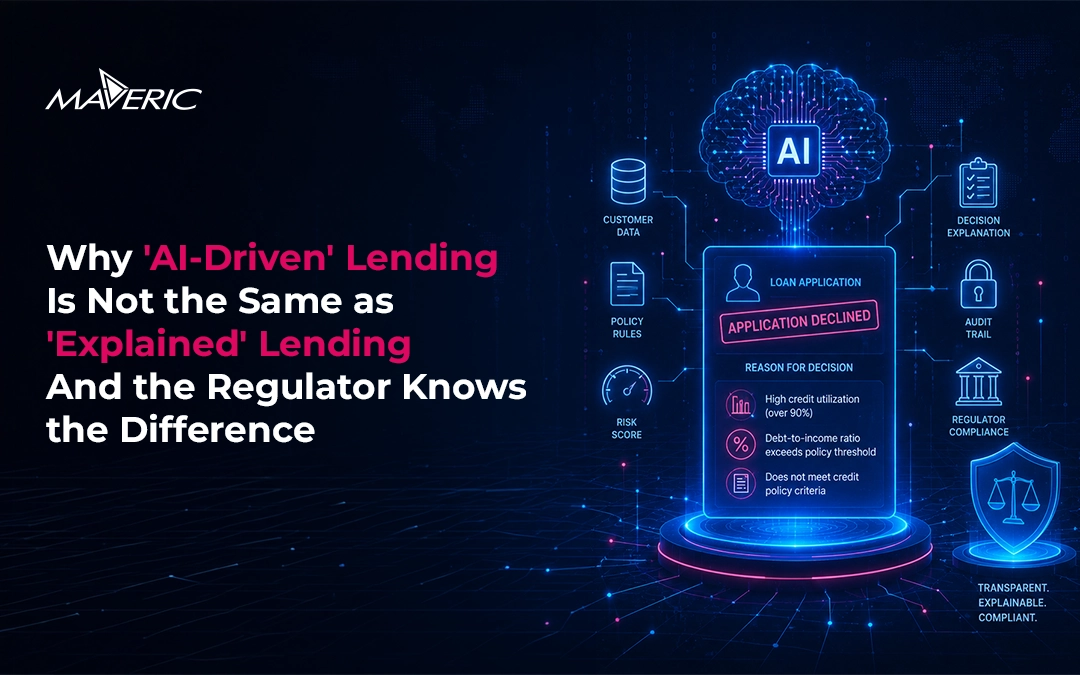
There is a regulatory reality about AI-driven credit decisions that is consistently underestimated by institutions deploying them at scale: automating the lending decision does not reduce the explanation obligation. In most regulatory frameworks, it increases the engineering requirement to meet it.
This is the distinction that separates compliance-ready lending automation from lending automation that will encounter regulatory challenge. And it is a distinction that has not been adequately built into most institutions’ credit automation architectures – not because the teams involved did not understand it, but because they conflated two things that sound similar and are architecturally different: model documentation and decision-level explainability.
What the Regulation Actually Requires
In the United States, the Equal Credit Opportunity Act and the Fair Credit Reporting Act require lenders to provide specific reasons for adverse credit decisions. The Consumer Financial Protection Bureau has stated explicitly – on multiple occasions and in multiple enforcement contexts – that the complexity of an algorithm does not exempt a lender from this obligation. In the United Kingdom, the FCA’s Consumer Duty requires firms to support customer understanding of adverse outcomes. Across the European Union, GDPR Article 22 provides individuals with the right to an explanation for automated decisions that significantly affect them, and the emerging AI Act framework extends obligations to transparency and human oversight for high-risk AI systems in credit.
The common thread across all of these frameworks: the explanation must be specific to the individual decision. Not a description of the model’s factors and how they are generally weighted. Not a statement that ‘credit scoring was used.’ A specific account of why this customer’s application was declined, at this moment, based on these inputs.
The enforcement record makes clear what happens when this standard is not met. Every major enforcement action against algorithmic credit decisions in the past decade has followed the same pattern: the institution was not penalised because the model produced incorrect outcomes. It was penalised because when asked why a specific decision was made, the institution could not produce a specific, accurate, timely answer. The model worked. The accountability infrastructure did not exist.
THE ENFORCEMENT PATTERN
Regulatory action on algorithmic credit decisions has not followed the failure of models to perform accurately. It has followed the failure of institutions to explain why models performed as they did. Accuracy without explainability is not compliance. It is accuracy plus exposure – the model makes the correct decision for the wrong documented reason, until the moment a regulator asks for the specific reason and discovers it cannot be produced.
The Difference Between Model Documentation and Decision-Level Explainability
These two things sound like they address the same requirement. They do not.
Model documentation describes how the model works in general: the features it considers, the training data it was built on, the validation process it underwent, the performance metrics it achieved. This documentation is produced once, at the point of model development or validation. It describes the model as a class of decision-maker. It does not describe any specific decision the model has made.
Decision-level explainability is different in kind. It is the ability to reconstruct, specifically and completely, why this model produced this output for this applicant at this moment – drawing on the specific data inputs consumed, the feature weights applied in the context of this particular combination of inputs, and the specific threshold conditions that produced an adverse rather than a positive outcome. It is produced for each decision. It requires infrastructure built into the model architecture at the point of design. It cannot be generated retrospectively from a general model description.
The institutions that have faced regulatory action for algorithmic credit decisions had the first and not the second. They could describe how the model worked in general. They could not explain why it made a specific decision for a specific person on a specific day. Those are not alternative approaches to the same requirement. They are different capabilities, and only one satisfies the regulatory standard.
Why This Is an Architecture Problem, Not a Model Problem
The most important implication of the model documentation / decision-level explainability distinction is this: the model itself is not the constraint. The architecture in which the model operates is.
A machine learning model does not automatically produce decision-level explanations. The feature importance scores and attribution mechanisms that are available for many model types provide a starting point – they can indicate which features contributed most strongly to a specific decision. But feature attribution in the general sense is not the same as the specific, human-readable, regulatorily compliant explanation that adverse action obligations require. That explanation requires infrastructure: a mechanism to capture the specific data inputs at the time of each decision, preserve them in the audit trail, and generate from them an explanation that is both technically accurate and communicable to the customer and regulator who will receive it.
Building this infrastructure is not a retrospective task. It cannot be added after a model is deployed without either rebuilding the model’s deployment architecture or relying on retrospective reconstruction – which is more expensive, less accurate, and slower than real-time explanation generation. The explanation infrastructure must be built at the point of model design, as an architectural requirement with equal standing to accuracy and throughput.
The credit automation programmes that have this infrastructure built in treat explainability as a design criterion from the beginning. The feature attribution mechanism is specified alongside the model architecture. The audit trail format is defined alongside the data schema. The explanation output format is agreed with compliance before the model is built, so that the explanation produced in production is the explanation that satisfies the obligation, not an approximation of it that must be reviewed and reformatted before it can be used.
The Additional Dimension AI Enables – and What It Requires
AI-driven credit decisions have an explainability dimension that human underwriting could never match at scale: the ability to trace the decision logic not just to the data inputs that informed it, but to the specific passage in the credit policy that governed it.
A human underwriter applies credit policy through judgment. They cannot, in most cases, cite the specific policy provision that governed a specific decision – particularly for boundary cases where multiple policy provisions interact. The decision traces to their assessment of the overall credit picture, informed by policy but not traceable to a specific provision.
An AI credit system operating with sentence-level policy lineage can trace the validation logic applied to any specific decision back to the exact passage in the credit policy that the validation reflects. The adverse action explanation is not just ‘these features contributed to a decline’ but ‘this decision reflects the credit policy’s requirement that applications with revolving credit utilisation above 90% are assessed at a higher risk tier – and this application met that condition.’ The explanation traces to governing authority, not just to model mechanics.
This makes AI-first credit compliance more defensible than human underwriting – not less. And it is only achievable when the credit policy governance layer is integrated with the decision explainability infrastructure from the point of model design.
What to Build – and When
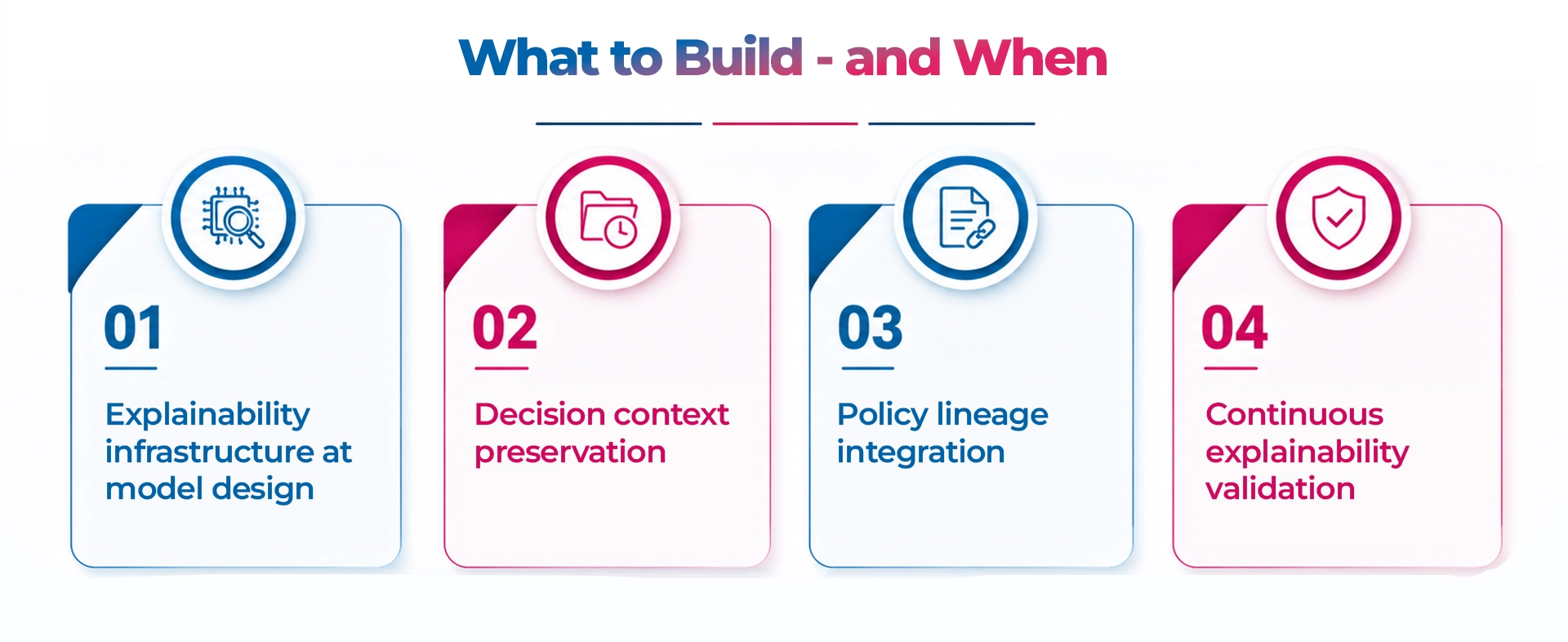
The governance implications for a credit automation programme are specific:
- Explainability infrastructure at model design – Not at model deployment. Not after the first regulatory challenge. Before the model is trained. The data capture mechanism, the audit trail format, the explanation generation process – all specified as architectural requirements with the same priority as model accuracy.
- Decision context preservation – For each adverse decision, the specific data inputs consumed at the time of the decision must be preserved in the audit trail for the duration of the applicable retention period. The model version that processed them. The explanation generated at that time. Not a reconstruction from current data. The actual decision context at the time.
- Policy lineage integration – The credit policy governance layer integrated with the decision explainability infrastructure, so that the explanation can reference the specific policy provisions the decision reflects – not just the data inputs, but the governing authority behind them.
- Continuous explainability validation – The explanation infrastructure validated in production, not just in testing. Automated checks that the explanation generated for each adverse decision meets the format, specificity, and regulatory completeness standards applicable law requires.
Moving from human to AI-driven credit decisions does not move the explanation obligation to the model. It moves the engineering requirement to meet that obligation to the institution. The model decides. The institution must explain. And the institution can only explain what its architecture was built to capture.
The full Automated Adverse Action Notice Infrastructure – feature attribution requirements, policy lineage integration, audit trail standards, and the governance architecture that makes AI-first credit compliance more defensible than human underwriting – is set out in CIO Mandate Series Paper 3.
Download: Engineering Trusted Automation in AI-First Banking Operations