

AI in financial services covers every use of artificial intelligence across banking, lending, wealth management, and capital markets, but the institutions that convert AI investment into business results are the ones that treat it as a core system change, not a collection of point solutions layered onto existing infrastructure.
For a CIO or CXO evaluating where to place the next AI dollar, that distinction determines whether the investment compounds or evaporates into a pilot backlog.
Financial Services Has Spent Heavily on AI. Most of That Spend Has Not Scaled.
Financial services ranks among the largest AI spenders of any industry, and the return on that spend has been uneven. Accenture’s research on banking AI adoption found that although the large majority of financial services executives have increased their generative AI investment plans, only about a third of organizations have actually scaled AI for a core business process. That gap is not a budget constraint. Most institutions can fund a pilot. Few have built the structural conditions that allow a pilot to become a production system a regulator, a customer, and an auditor can all trust simultaneously.
What Scaling AI Actually Requires in a Regulated Industry
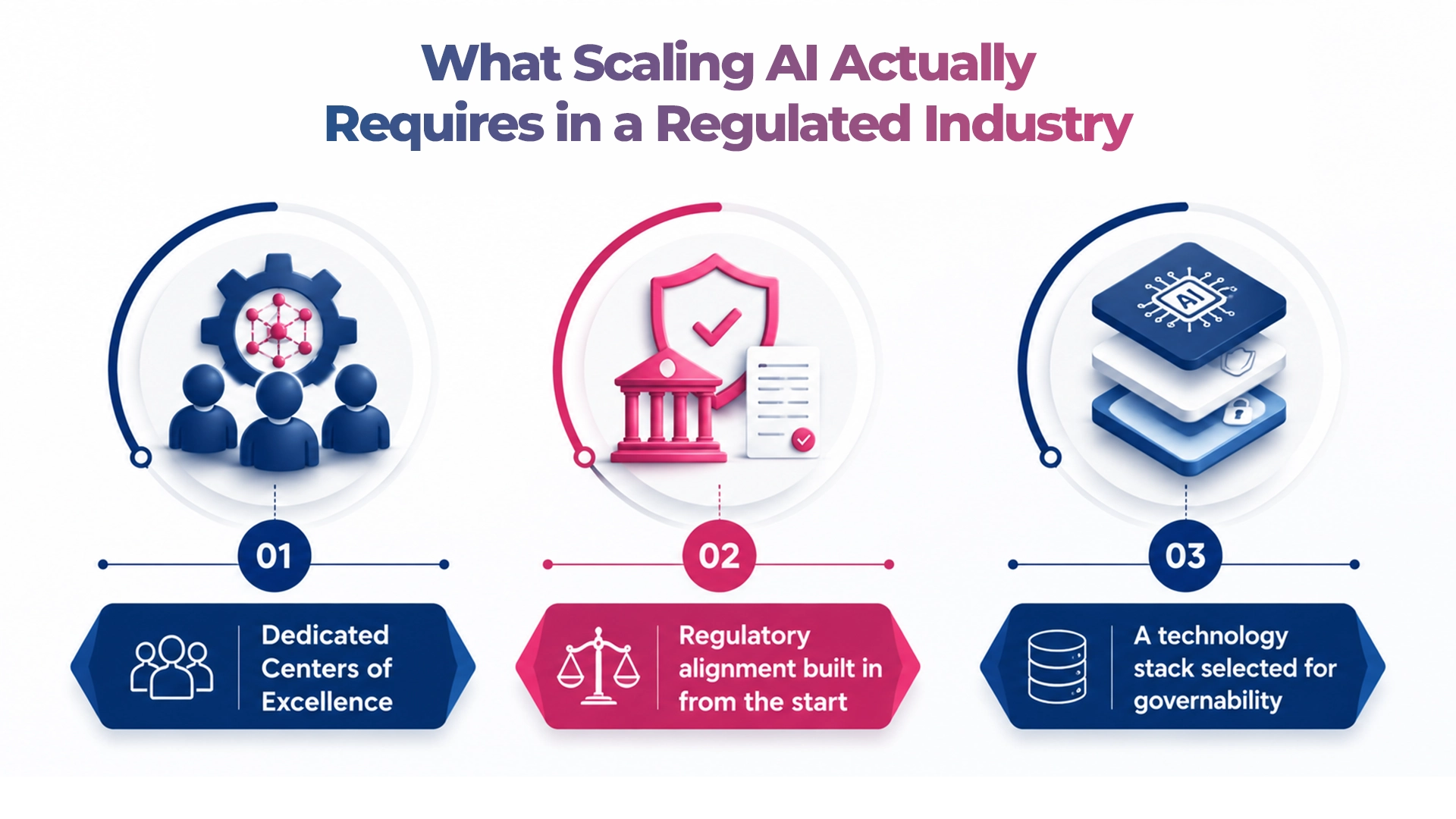
Outside financial services, scaling AI is largely an engineering and change-management problem. Inside financial services, it is also a regulatory design problem, which is why generic enterprise AI playbooks consistently underperform when applied to banking, lending, and wealth management. Three structural enablers tend to separate institutions that scale from those that do not:
- Dedicated Centers of Excellence spanning domain expertise, technology delivery, and data-for-AI, rather than a single central AI team expected to serve every business line.
- Regulatory alignment built in from the start, not appended after a use case is already live, given that frameworks including BCBS 239, SR 11-7 (now SR 26-2), and the EU AI Act’s high-risk classification for credit and risk models apply to financial services differently than to almost any other sector, and given that a US institution’s actual supervisor, the OCC, the FDIC, the NCUA, or the Federal Reserve, will apply these principles through its own examination lens.
- A technology stack selected for governability, not capability alone, since a model that cannot produce an audit trail constitutes a liability in financial services in a way it may not in retail or media.
The Case for Treating AI as a Core System Change
The prevailing instinct across most organizations is to treat AI as a new capability layered onto existing processes: a chatbot added to a call center, a recommendation engine added to a CRM. In financial services, that pattern consistently produces the same outcome, strong pilot results that never translate into enterprise-wide adoption, because the underlying systems of record were never built to support AI-generated, context-specific decisions at scale.
Institutions that scale AI successfully take a different approach. They embed AI into core systems, operations, and decision layers rather than running it as a parallel track alongside the systems that actually run the bank. This represents a heavier commitment at the outset, and it is also the only path that produces AI capable of surviving a regulatory examination once it is handling real credit, fraud, and compliance decisions rather than a demonstration.
Why ROI Discipline Matters as Much as Technical Capability
A significant share of financial institutions running AI initiatives do not share projected or realized gains from those initiatives at all, a signal that ROI is not being measured, rather than evidence that it does not exist. Research into where AI investment pays off in financial services consistently shows that initiatives anchored to customer experience outcomes generate stronger returns than initiatives anchored purely to cost reduction. This has a direct implication for how a Tier 2 or Tier 3 institution should sequence its own AI roadmap: the highest-return starting points are typically the processes where AI improves what the customer experiences directly, such as onboarding speed or servicing responsiveness, rather than the processes that happen to be easiest to automate internally.
What This Means for Financial Institutions Outside the Top Tier
None of the above requires a global bank’s budget or headcount. It requires sequencing: mapping regulatory requirements before development starts, scoping every AI initiative around a measurable business outcome before it begins, and building governance into the architecture rather than retrofitting it after an examination finding. Institutions with 25-plus years of exclusive focus on banking and financial services tend to execute this sequencing more consistently than generalist technology partners, precisely because the regulatory and operational context is not something being learned on the engagement itself.
What This Means for the CIO Agenda
The relevant question is no longer whether an institution is using AI in financial services. Nearly every institution can already answer that affirmatively. The question that actually predicts competitive outcome is whether that AI is embedded deeply enough, and governed rigorously enough, to continue generating value once it is carrying real regulatory and reputational weight, rather than simply performing well in a controlled pilot.
Further reading: the Architecture of Trust in AI-Driven Banking whitepaper, part of Maveric Systems’ research on AI-first banking.
FAQ
1) What does “AI in financial services” include beyond retail banking?
It spans retail banking, corporate and commercial banking, lending, wealth management, and capital markets, anywhere AI is used to automate decisions, generate insights, or interact with customers under a financial services regulatory regime.
2) Why do so many financial services AI pilots fail to scale?
Because scaling AI in a regulated industry is a regulatory design problem as much as an engineering one. Pilots that succeed on capability alone often cannot produce the audit trail, lineage, and governance a production deployment requires, so they stall rather than expand.
3) What structural factors help financial institutions scale AI successfully?
Dedicated Centers of Excellence spanning domain, technology, and data expertise; regulatory alignment built in from the architecture stage rather than added afterward; and a technology stack selected for governability, not just raw capability.
4) Does scaling AI in financial services require a large in-house data science team?
Not necessarily. It requires disciplined sequencing: mapping regulatory requirements before development, anchoring every initiative to a measurable business outcome, and building governance into the system rather than retrofitting it later. That discipline matters more than headcount.
5) Which AI use cases in financial services tend to generate the strongest ROI?
Initiatives anchored to customer experience outcomes, such as faster onboarding or more responsive servicing, tend to outperform initiatives scoped purely around internal cost reduction, based on research into AI investment returns across the industry.