

How enterprises are misreading the trusted AI mandate – and what it actually takes to operationalize trust at scale.
There is broad consensus that enterprise AI must be trusted to be useful. Where consensus breaks down is in what “trusted” actually means. The default instinct is to treat trust as a technology property: reliable models, clean data, robust infrastructure. If the platform holds up, the thinking goes, trust will follow.
This framing is understandable. It is also insufficient.
What is actually accumulating across most enterprises is something that might be called trust debt. Every AI output that cannot be fully explained, traced, or verified adds to it. Every deployment built on fragmented data or inconsistent context adds to it. The debt does not announce itself – it surfaces quietly, as verification overhead, as cautious containment of AI rather than confident scaling, as a widening gap between what AI produces, what the organization can explain, and what regulators expect to see. Most firms can demonstrate what their AI generates. Very few can demonstrate how it arrived there, why it should be trusted, or whether it will behave the same way tomorrow.
The real challenge of trusted AI is not resolvable in a model pipeline or a governance checklist. It is an organizational challenge – one that cuts across operating models, stakeholder relationships, decision frameworks, and data infrastructure. For banks and financial institutions, where regulatory accountability is non-negotiable and client relationships are built over decades, this is the difference between an AI initiative that scales with confidence and one that stalls under its own accumulated uncertainty.
The organizations that build lasting trust in AI are not necessarily those with the most sophisticated models. They are the ones that align their operating environments, governance structures, and stakeholder relationships around a coherent philosophy of accountability. Trust is not engineered into AI. It is operationalized across the enterprise.
“Trust is not engineered into AI. It is operationalized across the enterprise.”
Operating Model Readiness: The Prerequisite No One Talks About
Banks are built around deterministic expectations. A given input produces a given output. Risk frameworks, audit trails, and escalation paths are all calibrated for that certainty. AI does not operate this way. Without explicit boundaries, foundation models produce probabilistic, context-dependent outputs that resist the predictability institutional machinery depends on.
Compounding this is a challenge that sits below the model layer entirely: context. AI does not understand an organization – it depends entirely on the data and context it is given. When that context is fragmented across systems, inconsistently defined, or stripped of its business meaning during transformation, AI cannot produce reliable or explainable outcomes. The outputs may appear plausible. They are not trustworthy. This is not a model failure. It is an infrastructure failure, and no amount of model tuning will fix it. Semantic consistency, data lineage, and governed context are not technical nice-to-haves – they are the foundations on which any credible AI deployment must rest.
The operating architecture must reflect this. Hub-and-spoke governance structures have gained traction in large institutions precisely because they allow AI capabilities to be deployed consistently across business units while retaining centralized oversight for risk and compliance. Bounded systems – where AI operates within defined parameters – allow organizations to extract value without compromising the audit trails regulators expect. No transformation partner, however capable, can deliver trusted AI into an environment that is not ready to receive it. Operating model readiness is a prerequisite, not an afterthought.
Stakeholder-Specific Trust: Moving Beyond the Universal Claim
A persistent misconception in enterprise AI strategy is that trust can be defined universally – that a system trustworthy for one stakeholder is trustworthy for all. In practice, regulators, customers, employees, and partners each define trust through a different lens. Regulatory trust is built through explainability and auditable decision trails. Customer trust depends on consistent, fair outcomes. Employee trust requires the organizational permission and capability to exercise informed judgment. Partner trust needs confidence that integration will not create downstream exposure.
Supervisors, in particular, are now evaluating AI with a level of rigor that extends well beyond model performance. They expect firms to demonstrate what data was used, how it was structured and interpreted, how decisions were derived, and whether outputs can be reproduced. AI is increasingly treated as part of the system of record – and if it cannot meet the same evidential standards, it will not be permitted to operate at scale. Building trust with one stakeholder group does not automatically translate into trust with another. Technology is a foundation. Trust is built on top of it, through relationships that are earned and sustained.
Determinism and Judgment: A Necessary Tension
There is a seductive logic to the idea that trusted AI is essentially deterministic AI – that sufficiently rule-driven systems will have solved the trust problem. In practice, fully rule-driven structures do not exist in any functioning enterprise. Exceptions arise. Edge cases surface. Contextual nuances emerge that no rule set anticipated. In these moments, institutions need the capacity for accountable judgment: defensible decisions that take context into account, within clear escalation and review frameworks. Removing that capacity in the name of determinism does not produce trust. It produces brittleness.
The operating architecture needs to preserve meaningful space for human judgment at the inflection points that matter. What matters is that this judgment is not arbitrary – it must be explainable, reviewable, and governed. The existing fabric of governance structures should not be discarded in the rush to deploy AI. It should be preserved and extended, with AI adoption iterative enough to allow institutions to learn without dismantling the accountability infrastructure they have spent years building.
“Trusted AI does not mean removing human judgment. It means creating the conditions in which judgment can be exercised accountably.”
Transparency, Fairness, and Auditability: The Long Game
Enterprise relationships – with clients, regulators, and partners – are built over years. The conditions that sustain them are not fundamentally different from those that enable durable AI trust: transparency about how decisions are made, fairness in how obligations are structured, and accountability that holds even when inconvenient.
When Maveric first contracted with a European client, the agreement was structured to make mutual obligations genuinely mutual, and proactively extended benefits the client had not requested. When the client’s operational manager asked why benefits were being offered that had not been negotiated, the answer was simple: the arrangement should be fair. The outcome was significant. The client stopped treating the relationship as transactional and, over time, redirected business from other suppliers. A similar dynamic shaped a long-standing relationship with a regional bank – one whose commitment to transparent agreements led, years later, to an unsolicited reference that proved decisive in winning a major exchange contract.
These stories are not about contract mechanics. They illustrate that trust created through consistent, demonstrably fair behavior tends to compound. The same principle applies directly to AI. Trust debt accumulates silently – through outputs that could not be explained, decisions that could not be traced, and assurances that could not be verified. Paying it down requires more than better models. It requires governed data foundations, transparent decision logic, and a genuine organizational commitment to auditability. The questions that must be answerable for any significant AI-assisted decision are straightforward: who made this judgment, on what basis, and through what process? If those questions cannot be answered clearly, the decision cannot be defended. And if it cannot be defended, it cannot be trusted.
Trust as an Operating Principle
The enterprise AI conversation has been dominated for too long by the model layer. Performance benchmarks and platform capabilities matter – but they address only one dimension of a much larger challenge. The trust gap in enterprise AI is not primarily a model problem. It is a system problem: fragmented data, inconsistent context, ungoverned lineage, and operating models that were never designed to support explainable, accountable AI at scale.
Closing that gap requires operating model alignment, stakeholder-specific trust frameworks, a thoughtful integration of determinism and human judgment, and a fundamental commitment to transparency and auditability. None of this is reducible to a technology solution. It is a philosophy of institutional responsibility – one that treats AI not as a platform to be deployed but as a capability to be governed, with the same discipline any significant institutional capacity demands.
Every unexplained output, every unverifiable decision, every deployment built on an unstable data foundation adds to the trust debt enterprises will eventually have to repay. The organizations that take operating model readiness seriously now – and build accountability into their AI infrastructure from the ground up – will not just avoid that reckoning. They will be the ones their clients, regulators, and partners choose to grow with.
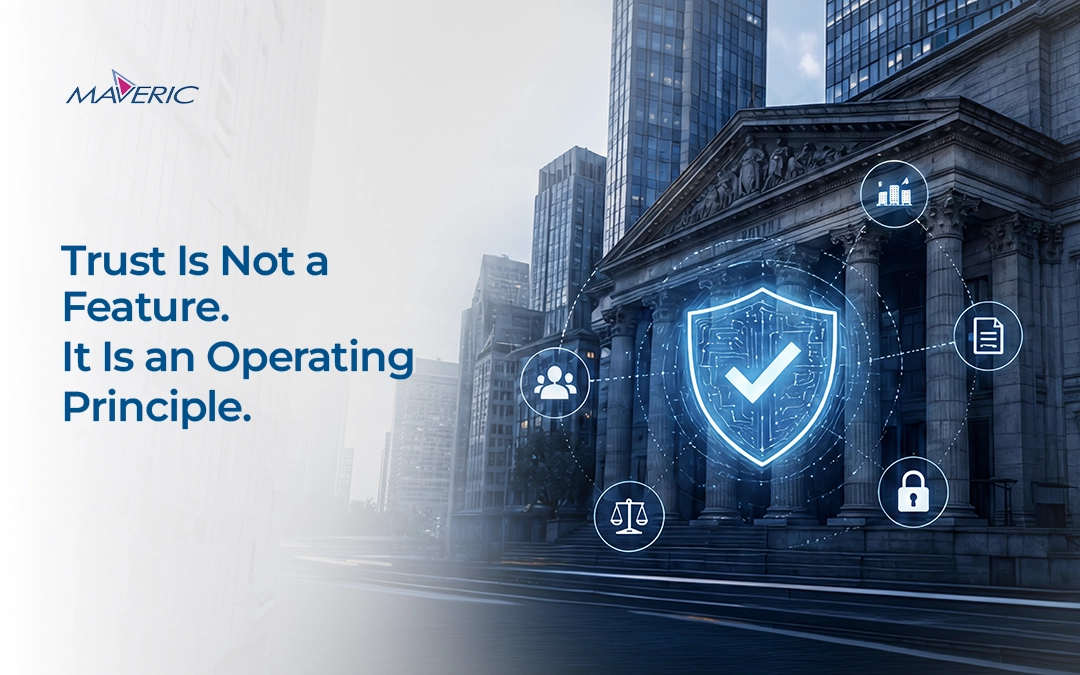
Trust is not a feature. It is an operating principle.
Engineering Trust in AI-First Banking
Maveric Systems partners with global banks to move from model accuracy to model accountability – embedding AI at the core of banking operations, not at the edges.Our approach is built on four pillars: AI at the Core and not at the Edges, Principles that Engineer Trust, Pragmatic and Outcome driven Approach and 25 years of Deep Banking DNA across retail, corporate, wealth management, and capital markets.
Click to know more – Engineering Trust in AI-First Banking Trust
FAQ
1. What is the difference between treating trust as a technology feature versus an operating principle in AI-first banking?
Treating trust as a technology feature means assuming that if the model performs well and the platform is stable, trust will follow automatically. Treating trust as an operating principle means recognising that reliable outputs are necessary but not sufficient – that trust requires the organisation’s data foundations, decision frameworks, governance structures, and accountability mechanisms to be deliberately aligned around AI. The distinction is the difference between a platform that works and an institution whose AI decisions can be explained, defended, and replicated under examination.
2. What is trust debt in enterprise AI, and how does it accumulate in a banking context?
Trust debt is the gap that accumulates between what an institution’s AI systems produce and what the organisation can explain, trace, and verify about those outputs. It builds silently – through every AI decision that could not be reconstructed on demand, every deployment built on fragmented or inconsistently governed data, and every output that appeared plausible but could not be evidenced. In banking, where regulatory accountability is non-negotiable, trust debt does not announce itself until it surfaces as a failed examination, an enforcement action, or a model that cannot be defended in a customer dispute. By that point, the cost of closing the gap is a multiple of what governed deployment would have required from the start.
3. Why is operating model readiness described as the prerequisite no one talks about?
Because most AI transformation conversations focus on the model layer – accuracy benchmarks, platform selection, use case deployment – while the operating environment that AI must work within is treated as a given. Banks are built around deterministic expectations: a given input produces a given output, and risk frameworks, audit trails, and escalation paths are calibrated for that certainty. AI produces probabilistic, context-dependent outputs that do not fit that institutional machinery without deliberate redesign. Operating model readiness means establishing the data governance, context consistency, human oversight structures, and governance accountability that allow AI to operate reliably within a banking environment – before scale reveals the gaps.
4. How should banks approach the tension between AI-driven automation and the need for human judgment?
The answer is not to resolve the tension but to govern it. Fully deterministic, rule-driven systems do not exist in any functioning enterprise – exceptions arise, edge cases surface, and contextual nuances emerge that no rule set anticipated. Removing human judgment in the name of determinism does not produce trust; it produces brittleness. What trusted AI actually requires is that human judgment at critical inflection points is explainable, reviewable, and governed – not arbitrary. Existing governance structures should be preserved and extended into AI deployment, not discarded in the rush to automate. The right standard is not “AI decided” or “human decided” but “was the decision – whatever its source – accountable?”
5. Why does trust need to be defined differently for regulators, customers, employees, and partners – and what does that mean practically?
Each stakeholder group defines trust through a different lens, and a system that satisfies one definition does not automatically satisfy the others. Regulatory trust requires explainability and auditable decision trails – supervisors now expect firms to demonstrate what data was used, how decisions were derived, and whether outputs can be reproduced. Customer trust depends on consistent, fair outcomes that do not vary based on factors the customer cannot see or challenge. Employee trust requires the organisational permission and capability to exercise informed judgment rather than blindly executing AI outputs. Partner trust needs confidence that integration will not create downstream liability. In practice, this means AI governance cannot be a single framework applied uniformly – it must be segmented by stakeholder and use case, with different explainability standards, oversight mechanisms, and accountability structures for each context.
6. What does it practically mean for an institution to operationalise trust rather than engineer it into AI?
Operationalising trust means aligning the entire institutional environment – operating model, data infrastructure, governance structure, and stakeholder accountability – around a coherent philosophy of accountability, not just deploying better-governed models. Concretely: it means data lineage and consistency are enforced at the point of model consumption, not assumed from source system reports. It means human oversight is built into the decision workflow at the inflection points that matter, with clear escalation paths. It means governance accountability is not siloed in a risk committee that reviews models quarterly – it operates at the speed of the delivery pipeline. And it means explainability is an architectural requirement decided at model design time, not a reporting layer retrofitted after deployment. Institutions that operationalise trust build the conditions in which AI can be scaled with confidence. Those that rely on model-layer trust alone accumulate the debt that eventually makes scaling impossible.