


The excitement around artificial intelligence today mirrors the dot com era of the late 1990s: rapid valuations, high investor interest, and widespread optimism. However, the AI ecosystem benefits from lessons learned across enterprises, investors, and regulators. For C-suite leaders, the key question is how to separate hype from strategic opportunity.
The Dot Com Playbook: Understanding What Went Wrong
The dot com bubble saw unprecedented venture capital inflows and IPO activity. Many companies with limited revenue attracted massive investments. Yet, interest rate hikes, Y2K cycles ending, and corporate scandals led to a market collapse.
Surviving companies adopted disciplined approaches: phased implementation, validated demand, and strong governance. Investors refined portfolio strategies, emphasizing burn multiples, milestone-based funding, and diversified exposure. Analysts strengthened evaluation frameworks, while regulators introduced mandatory corporate governance reforms.
These historical lessons provide a playbook for today’s AI strategies.
AI in 2025: Controlled Growth Amid Hype
Since 2022, generative AI has spurred enormous investment: hyperscaler capex exceeded $350B, global AI startup funding neared $90B, and U.S. startup funding crossed $200B.
Unlike the internet in 2000, the AI ecosystem exhibits early signs of rationalization:
- Major players are moderating investment ramps.
- Forecasts are being refined.
- Market narratives are more carefully managed.
C-suite executives should pay attention to three critical indicators:
- Circular monetization models dependent on hyperscalers.
- Data center pipelines exceeding near-term utilization.
- Equity market volatility around AI-linked valuations.
High-Value AI Opportunities for Enterprises
Not all AI initiatives deliver value equally. Leaders should focus on:
- Compute & Infrastructure: Chipmakers and data center operators see consistent demand.
- ROI-led Enterprise AI: Predictive maintenance, quality optimization, and operational efficiency projects scale successfully.
- Scientific AI: Drug discovery, materials engineering, and complex simulations offer durable impact.
Conversely, frontier LLMs, autonomous coding tools, and pure-play AI cybersecurity solutions face consolidation pressures due to high integration dependencies and profitability challenges.
Turning Hype into Sustainable Value
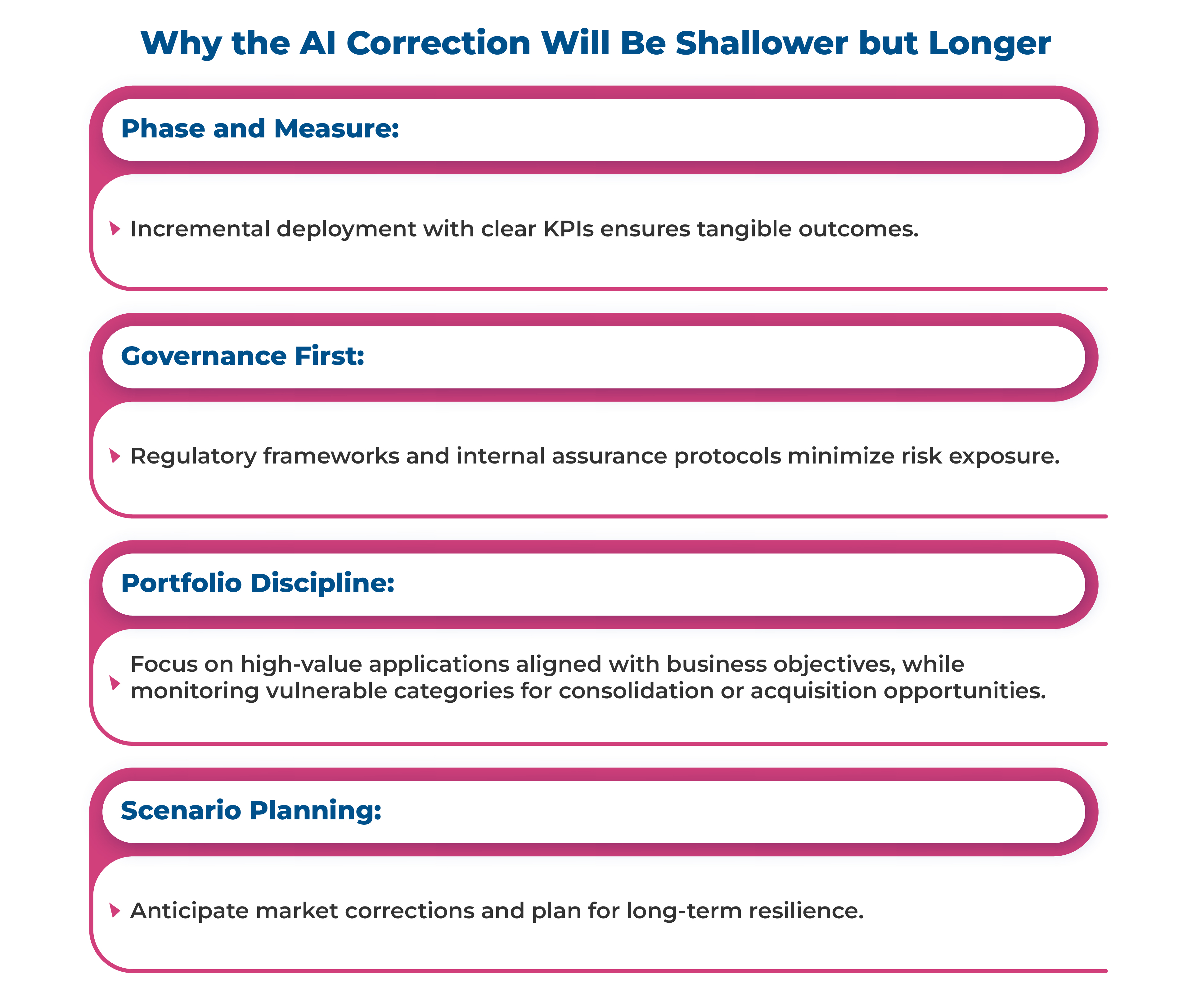
The AI market is poised for a 30–50% correction, less severe than the dot com crash but prolonged due to deep integration. Strategic leaders who combine historical lessons with disciplined execution will capture disproportionate value.
AI adoption today is a generational opportunity to build enterprise resilience, drive measurable ROI, and enable scalable innovation. Leaders who navigate the hype with foresight will emerge stronger in the coming consolidation phase.
Explore the full blog for actionable insights and strategic guidance on AI adoption and sustainable growth.
FAQ
Why is AI often compared to the dot com era?
AI is compared to the dot com era because both periods are marked by rapid valuation growth, intense investor interest, and narratives that outpace real-world adoption. The comparison helps leaders recognize early warning signals and avoid repeating past mistakes.
What lessons from the dot com crash are most relevant to AI today?
The most relevant lessons include the importance of phased adoption, validated customer demand, measurable returns, and strong governance. Companies that survived the dot com crash focused on disciplined execution rather than speed alone.
Why is the current AI cycle expected to be more stable than the dot com bubble?
Unlike the dot com era, today’s AI ecosystem operates within mature digital infrastructure, stronger regulatory oversight, improved financial discipline, and more sophisticated enterprise evaluation frameworks, reducing the risk of a sudden collapse.
What signals suggest AI investments are being rationalized in 2025?
Key signals include moderated investment ramps by hyperscalers, refined financial forecasts, and more cautious public positioning by major technology firms—indicating recalibration rather than unchecked expansion.
Which AI opportunities offer the highest enterprise value?
High-value AI opportunities include compute and infrastructure platforms, ROI-led enterprise applications such as predictive maintenance and quality optimization, and scientific AI used in drug discovery and advanced simulations.
Which AI segments face higher risk of consolidation?
Frontier LLM providers, autonomous coding tools, and pure-play AI cybersecurity platforms face higher risk due to high integration complexity, differentiation challenges, and unclear profitability paths.
What strategic indicators should C-suite leaders monitor in AI investments?
Leaders should track hyperscaler dependency, data center utilization rates, AI project payback timelines, regulatory exposure, and capital efficiency across AI portfolios.
What is the most effective approach for enterprises to adopt AI today?
The most effective approach is disciplined, phased deployment with clear ROI benchmarks, strong governance, and alignment to core business priorities rather than experimental scale.
What is the key leadership takeaway from the current AI hype cycle?
The key takeaway is that sustainable value will accrue to organizations that apply historical lessons with strategic discipline—balancing innovation with governance, realism, and long-term execution