


There is a pattern appearing across banking AI customer service deployments with enough consistency that it deserves a name. Call it the FCR plateau.
It works like this: an institution deploys AI agent assist or an AI-driven customer service platform. First Call Resolution improves – materially, sometimes dramatically. 20%, 25%, 30% improvement in the first quarter. The leadership team is pleased. The business case is being validated.
Then the improvement stops. Second quarter results show a plateau at roughly the same level as the end of quarter one. The team investigates. The model has not degraded. The training data has not obviously deteriorated. The platform vendor cannot identify a technical explanation. The improvement has simply ceased.
This pattern is not a model problem. It is a data surface problem. And once you understand the mechanism, the plateau is not just explainable – it is entirely predictable.
What the First 25% Improvement Captures – and What the Plateau Reveals
The first wave of FCR improvement from AI customer service comes from the most accessible layer of the data the model can reason over: structured interaction history. Call date, call duration, issue category, resolution code, product involved, channel used. This data is typically well-governed, readily accessible, and easily integrated into an AI agent assist system.
When an AI system can access this structured history, it arrives at each customer interaction already knowing that this customer called three times in the last six weeks about the same issue, that the issue was categorised as a billing dispute twice and an account access problem once, and that neither previous interaction reached a resolution. That context allows the agent assist system to route the interaction more intelligently, suggest more relevant responses, and reduce the time spent reconstructing a situation the customer has already explained to two previous agents.
This is genuine, measurable improvement. And it is captured relatively quickly – because the structured data is available, the integration is straightforward, and the model can deploy this capability across the full customer interaction volume from early in the deployment.
The plateau appears at precisely the point where structured interaction metadata has yielded its improvement. What lies beyond it – the next layer of FCR improvement – requires something the model does not have: the semantic content of those prior interactions. Not just that a call happened and how long it lasted. What the customer actually said. What they were trying to communicate. What the emotional register of the interaction was. Whether the previous agent’s resolution was accepted or whether the customer left the call unsatisfied despite the interaction being marked as resolved.
THE DISTINCTION THAT CHANGES EVERYTHING
In a CRM-based automated service model, a customer’s interaction history consists of structured fields: call codes, product categories, resolution outcomes. The content of what the customer said – the nature of their complaint, the specific feature they were asking about, the frustration in their third call about the same issue – existed in call notes and transcripts but was invisible to the automation logic. The automation could see that a call occurred and how long it lasted. It could not understand why the customer was calling or what they actually needed. AI changes this. The semantic content of prior interactions becomes part of the decision surface. This is not an incremental improvement on structured data processing. It is a different layer of the architecture entirely.
What Reasoning Over Semantic Content Actually Means in Practice
Consider a customer who has called the bank three times in six weeks about early repayment charges on their mortgage. The structured history records three calls, each categorised under ‘mortgage – fees and charges,’ each marked as resolved after the agent explained the fee schedule.
What the structured history does not record: that on the first call the customer said they were considering paying off the mortgage but found the fee calculation unclear. On the second call they said they had spoken to a financial advisor who questioned whether the fee applied to their specific product type. On the third call they said they felt they had been given inconsistent information and were considering making a formal complaint.
An AI system that can only access the structured history sees three calls about fees, all resolved. An AI system that can reason over the semantic content of those interactions sees a customer who is moving toward a complaint about inconsistent information, who has a specific question about product applicability that has not been clearly answered, and who has been told three times that their question has been resolved when it demonstrably has not been.
Those are two completely different starting points for the fourth interaction. One will likely produce a fourth partial resolution and move the customer closer to a formal complaint. The other has a genuine chance of resolving the underlying issue – if the agent assist system can surface the actual question, the previous information inconsistency, and the appropriate resolution path.
That is the FCR improvement that lies beyond the plateau. And it is only accessible when the model can reason over the semantic content of what the customer has actually said – not just the categorical metadata of the interactions they have had.
Why This Is a Data Infrastructure Problem, Not a Model Problem
The model that produced the first-quarter improvement is capable of producing the second phase of improvement. The constraint is not its intelligence. It is the data surface it can access.
Extending the model’s decision surface to include semantic content requires three things that most institutions did not build into the initial deployment: a governed unstructured data layer that makes interaction content accessible to the AI system in real time; data contract governance specifying the freshness and completeness standards that content must meet to be relied upon; and the context transfer protocols that preserve semantic context when interactions move between AI handling and human agents.
Without these, the AI system has the equivalent of a researcher who can see the bibliographic record of every book in a library but cannot read any of them. The records tell them what exists. They cannot tell them what any of it means.
The institutions that have broken through the FCR plateau have done so not by upgrading their models but by extending the data surface those models can reason over. The improvement is not in the model’s intelligence. It is in the completeness of what the model is allowed to be intelligent about.
What to Check If Your Programme Has Plateaued
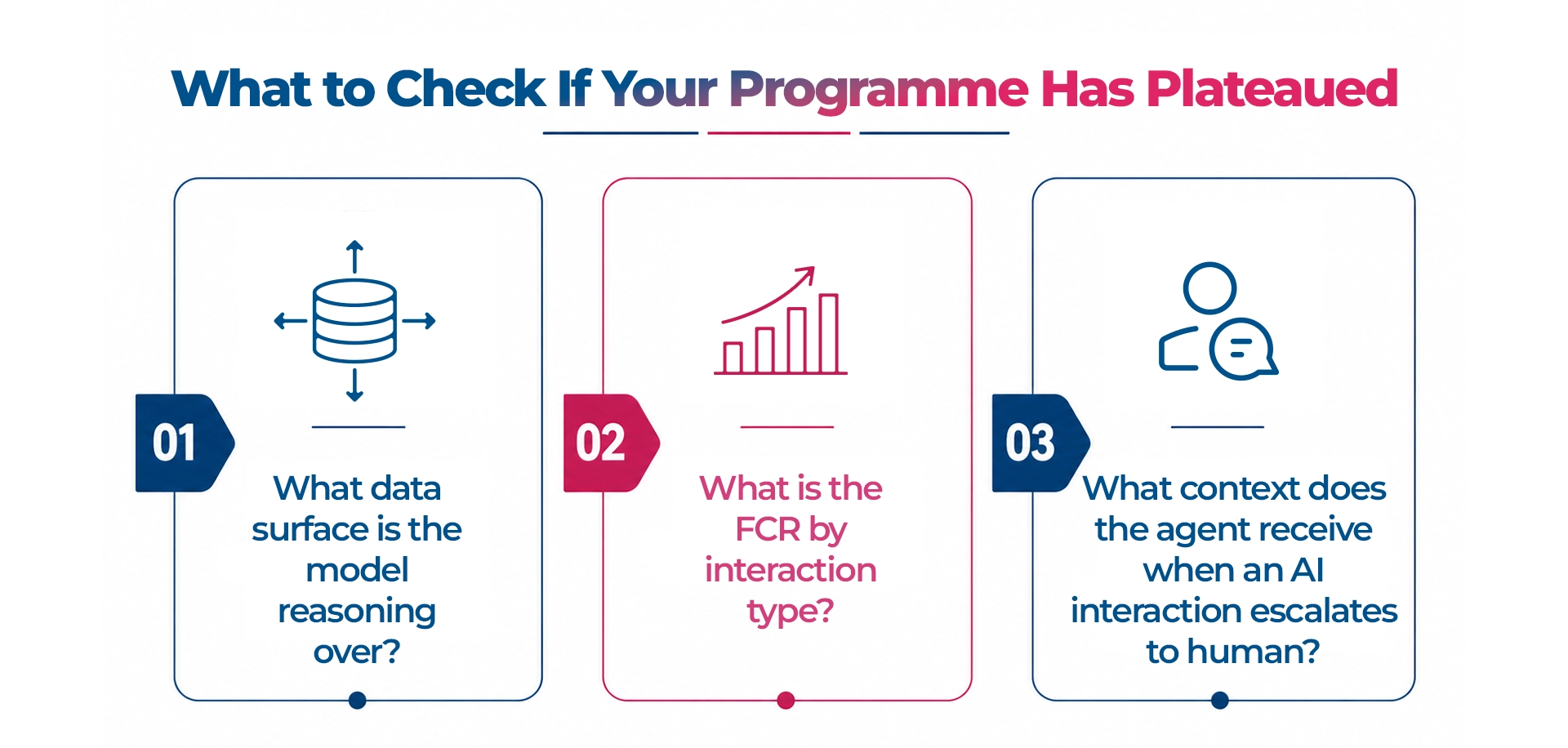
If your AI customer service deployment has reached a FCR plateau, three diagnostic questions locate the cause:
- What data surface is the model reasoning over? – Specifically – is it accessing the semantic content of prior customer interactions, or only the structured metadata? If the answer is structured metadata only, the plateau is the ceiling of what that data can support.
- What is the FCR by interaction type? – Aggregate FCR metrics mask the distribution. Simple, single-issue interactions that were always resolvable with structured data may be at 90%+ FCR. Complex, multi-issue interactions requiring contextual understanding may be at 40%. The aggregate looks acceptable. The distribution reveals where the next improvement lies.
- What context does the agent receive when an AI interaction escalates to human? – If the answer is ‘the customer is transferred and the agent starts from scratch,’ the context transfer architecture is absent – and every improvement the AI achieved in understanding the customer’s situation is lost at the handoff.
The FCR plateau is not a signal that AI customer service has reached its limit. It is a signal that the data surface the model is reasoning over has reached its limit. Those are different problems with different solutions.
The First Call Resolution Architecture – what the unstructured data layer requires, how context transfer protocols between AI and human agents are governed, and why FCR monitoring must be conducted at the interaction type level not the programme level – is set out in full in CIO Mandate Series Paper 3.
Download: Engineering Trusted Automation in AI-First Banking Operations