


If your bank knew last month that a customer had started paying rent in a new city, what did it do with that knowledge?
For most banks, the honest answer is nothing, or a generic offer weeks later. The bank had the signal in its transaction data. It lacked the means to recognize it as a life event, decide what would help, and act while it still mattered.
That gap shows up clearly in what customers report. J.D. Power’s 2026 Financial Health Support and Advice Study found that just 20% of bank customers say their bank always personalizes the information they receive. Yet when banks get personalization right, customer satisfaction rises by 238 points on a 1,000-point scale. J.D. Power’s Jennifer White summarized the state of the industry: “Personalization is still more promise than reality.”
Personalization in banking is one of the oldest promises in the industry. It is worth asking why it has been so hard to keep, and what is different now.
Customers Want It, and Barely Use What Exists
The demand is not in doubt. The Accenture Banking Consumer Study 2025, based on 49,300 customers in 39 countries, found that 72% say personalization influences their choice of bank. The same study found that just 3% use the personalization tools their banks provide.
Both findings can be true at once because most of what banks call personalization is something the customer has to set up: a budgeting tool to configure, alert preferences to manage, a dashboard to visit. That is self-service personalization, and it asks the customer to do the work of being understood. The personalization customers value is the kind that arrives without being configured, at the moment it is relevant.
J.D. Power’s advice study points the same way. While 47% of customers recall receiving advice from their bank, fewer than one in six are aware of new financial health resources being introduced, and the study found limited evidence that advice is leading to sustained action.
The Real Constraint Was Never Only Data
The usual explanation for weak personalization is fragmented data: core banking, CRM, cards and digital behavior in separate systems with no single view of the customer. That explanation is correct, and it remains the first thing most regional banks have to fix.
From Digital-First to AI-First argues that the deeper limit was the model. Traditional next-best-action engines were built by data scientists for an anticipated outcome, trained on historical data and run in batches. They flagged product opportunities from static demographics or a single recent transaction. When the customer’s context changed, the model did not.
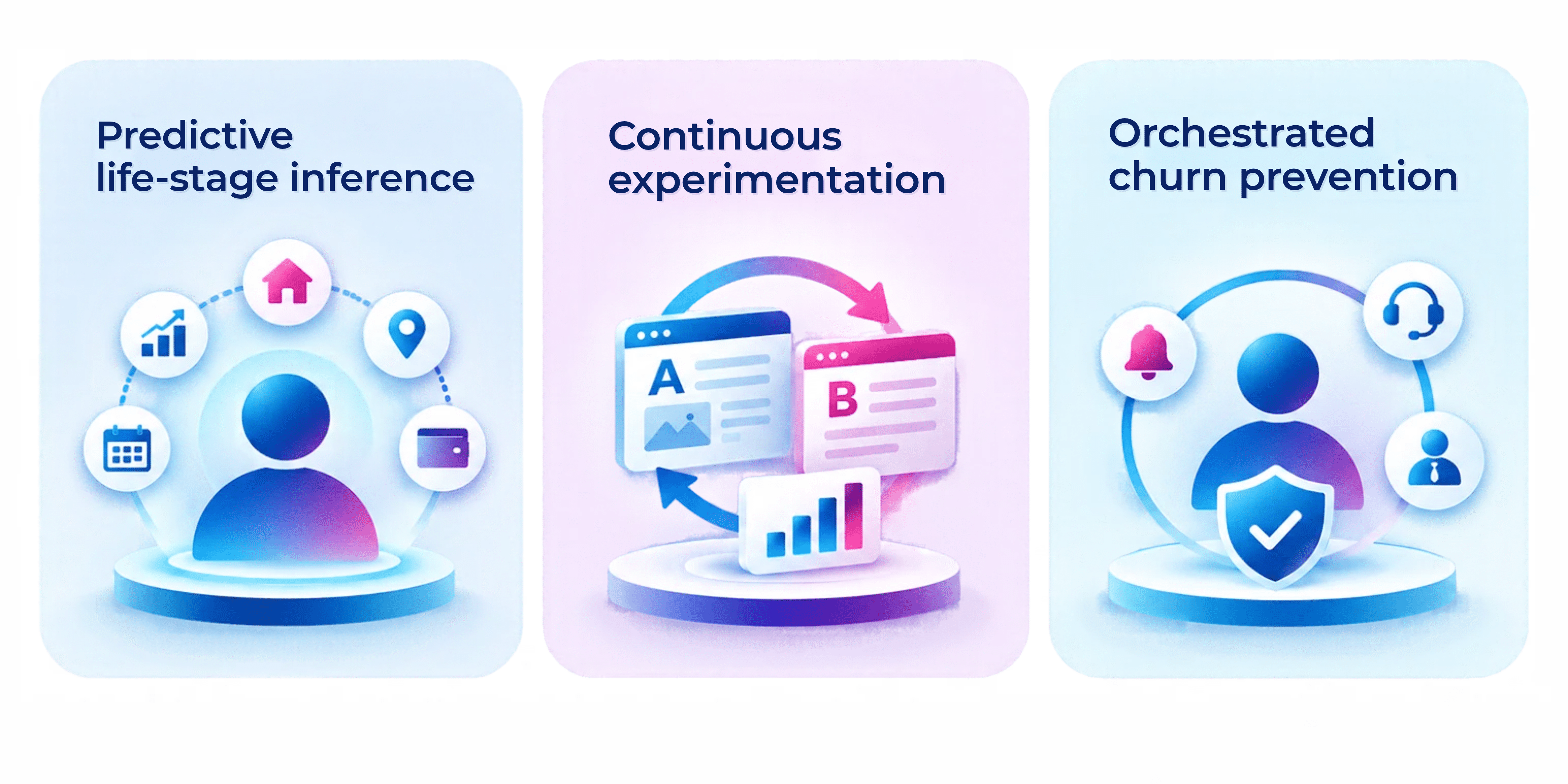
AI-first personalization works differently in three ways the whitepaper describes:
- Predictive life-stage inference. The bank combines many weaker signals that were never linked, such as a steady change in salary deposits, a new rental payment, a change of location or new browsing patterns, to infer a life event before the customer announces it.
- Continuous experimentation. Instead of marketing teams designing and coding each A/B test by hand, the system tests messages, timing and channels continuously and learns what works for each customer, which reduces what the whitepaper calls iteration fatigue.
- Orchestrated churn prevention. When behavior suggests a customer is drifting, such as falling product usage or gradually declining balances, the system does more than flag the account. It triggers tailored outreach, or routes high-value customers to a relationship manager with a brief on what is likely to keep them.
The third capability matters more now than it did a few years ago. With customers spreading deposits across several institutions, drift is often the only warning a bank gets.
Relevance or Pressure: The Customer Decides
Personalization uses the most sensitive data a bank holds, and customers know it. The Accenture study found that 84% of customers worry about how their data is used, and only 26% are interested in their bank making extensive use of AI to analyze their data for more personalized services. It also found that 46% feel pressured at least some of the time to accept products that serve the bank more than themselves, and 51% feel bombarded by advertising.
These figures explain why so much personalization fails to earn trust. The customer judges each message by one question: is the bank helping me, or selling to me? An alert that a payment will overdraw the account, with a cheaper way to cover it, reads as help. A credit card offer the day after a large deposit reads as surveillance.
A practical test for any personalized engagement is whether the bank would be comfortable explaining to the customer, in plain language, which data triggered it and why. If the honest explanation would make the customer uneasy, the engagement is probably costing more trust than it earns.
This is also why data governance in banking belongs inside the personalization program. Knowing which data may be used for which purpose, recording consent, and being able to explain why a customer saw a particular offer are the conditions for using richer signals at all.
The New Competitor for the Advice Relationship
There is a further reason to act. J.D. Power’s advice study found that 53% of customers had turned to artificial intelligence for financial advice in the past three months, which it described as a growing threat to traditional channels.
If general-purpose AI assistants become the place customers go to understand their finances, banks risk being reduced to the place where customers execute decisions made elsewhere. A bank’s advantage is the data it holds and the trust it has earned. Personalization that uses both well is how a bank stays part of the conversation before the decision.
Where to Start
For most regional banks, a sensible sequence is:
- Fix the customer view for one journey. Join core, card, digital and CRM data for the customers in one product line, and resolve identity across them. A narrow, complete view beats a broad, partial one.
- Start with service-led personalization. Alerts that prevent fees, warnings about unusual spending and reminders before a rate change are relevant, easy to explain and build trust before any selling begins.
- Add life-event detection for a small number of events. Moves, new employment and the arrival of regular new payments are among the clearest. Test what helps the customer at each one.
- Route drift to people. Use churn signals to brief relationship managers on high-value customers before automating outreach to everyone.
Measure Commercial Impact and Trust Together
Many banks measure personalization by engagement: opens, clicks and app visits. These show activity and say little about value. A measurement set that justifies further investment tracks:
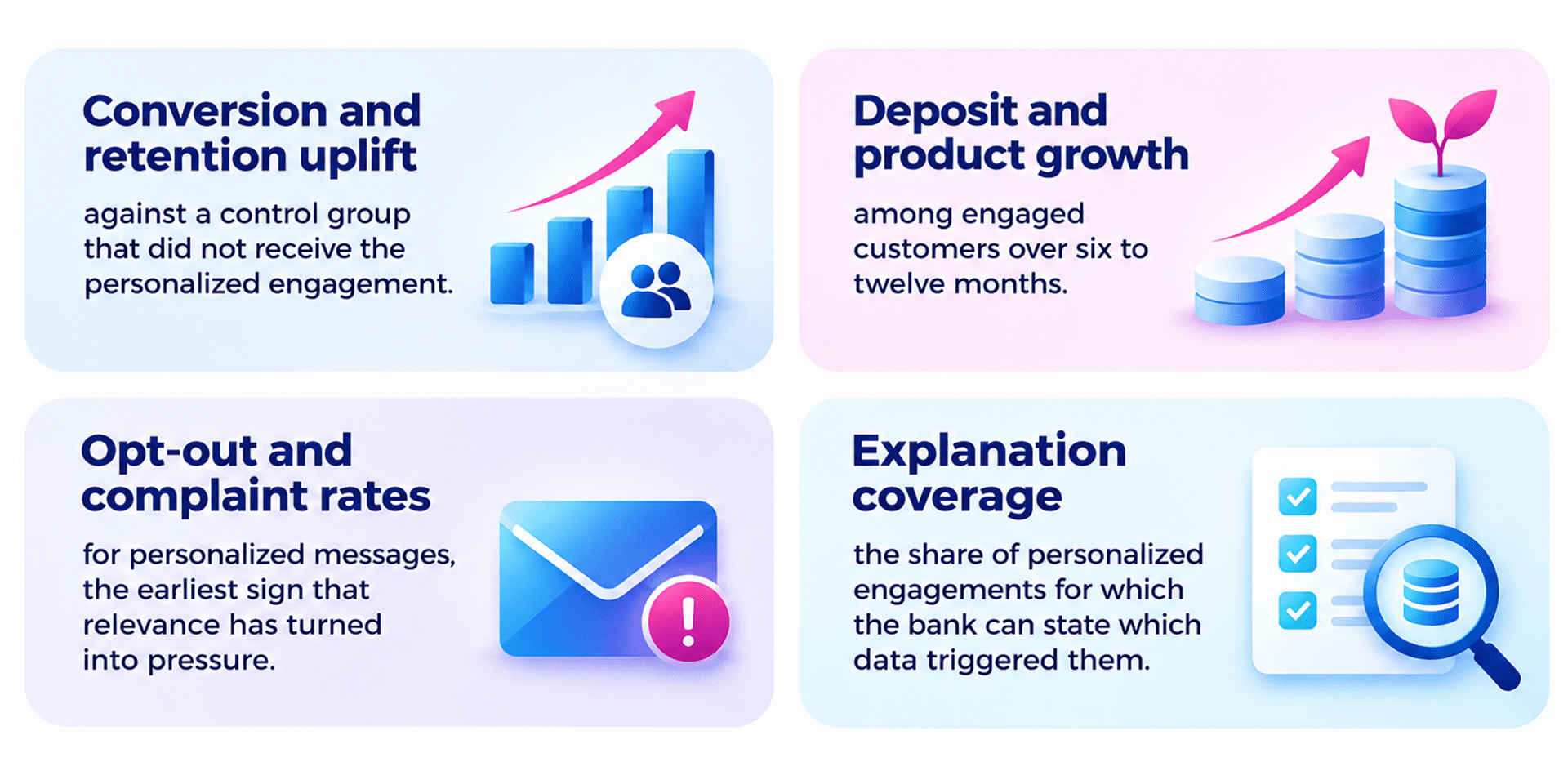
- Conversion and retention uplift against a control group that did not receive the personalized engagement.
- Deposit and product growth among engaged customers over six to twelve months.
- Opt-out and complaint rates for personalized messages, the earliest sign that relevance has turned into pressure.
- Explanation coverage: the share of personalized engagements for which the bank can state which data triggered them.
Score Your Personalization Readiness
Hyper-personalization and predictive engagement carries 20% of the weight in the CX Readiness Assessment from Maveric Systems, the joint highest of the six dimensions. Its six capabilities, from a unified customer data foundation to measuring commercial impact, show whether your bank personalizes from inference or from segments. The customer experience in banking guide explains how personalization depends on onboarding, trust and feedback.
Which of your customers changed jobs, moved home or started a family this year, and which of them heard something useful from your bank before they heard from a competitor?
Personalization in Banking Key Questions
What is personalization in banking?
Personalization in banking means tailoring information, advice, offers and service to an individual customer’s situation and needs. AI-first personalization infers needs from behavior and life events in real time, rather than relying on static segments or customer-configured tools.
Why do banks struggle with personalization?
Customer data is often split across core, card, CRM and digital systems, and traditional next-best-action models were built for anticipated outcomes and run in batches, so they miss changes in context. Customer concern about data use also limits what banks can do without clear consent and explanation.
What is hyper-personalization in banking?
Hyper-personalization combines many signals, such as transaction patterns, payments and digital behavior, to infer an individual customer’s life stage and needs, then delivers the right message or offer at the right moment and keeps testing what works for that customer.
How do banks make personalization trustworthy?
Start with personalization that clearly helps the customer, such as fee-avoidance alerts, use only data the bank is permitted to use for that purpose, be able to explain why a customer received each message, and monitor opt-out and complaint rates as early warnings that relevance has turned into pressure.