Your developers already have AI. What your agents don’t have is your institution: the credit policy behind a rule, the decision behind an architecture pattern, the incident behind a regression test.
Every SDLC hand-off – demand to requirement, requirement to design, design to code, code to test – is a compression event. Experienced people used to fill the gaps from memory. Agents can’t. They produce code that works and fails at the same time: technically correct, operationally or regulatorily wrong.
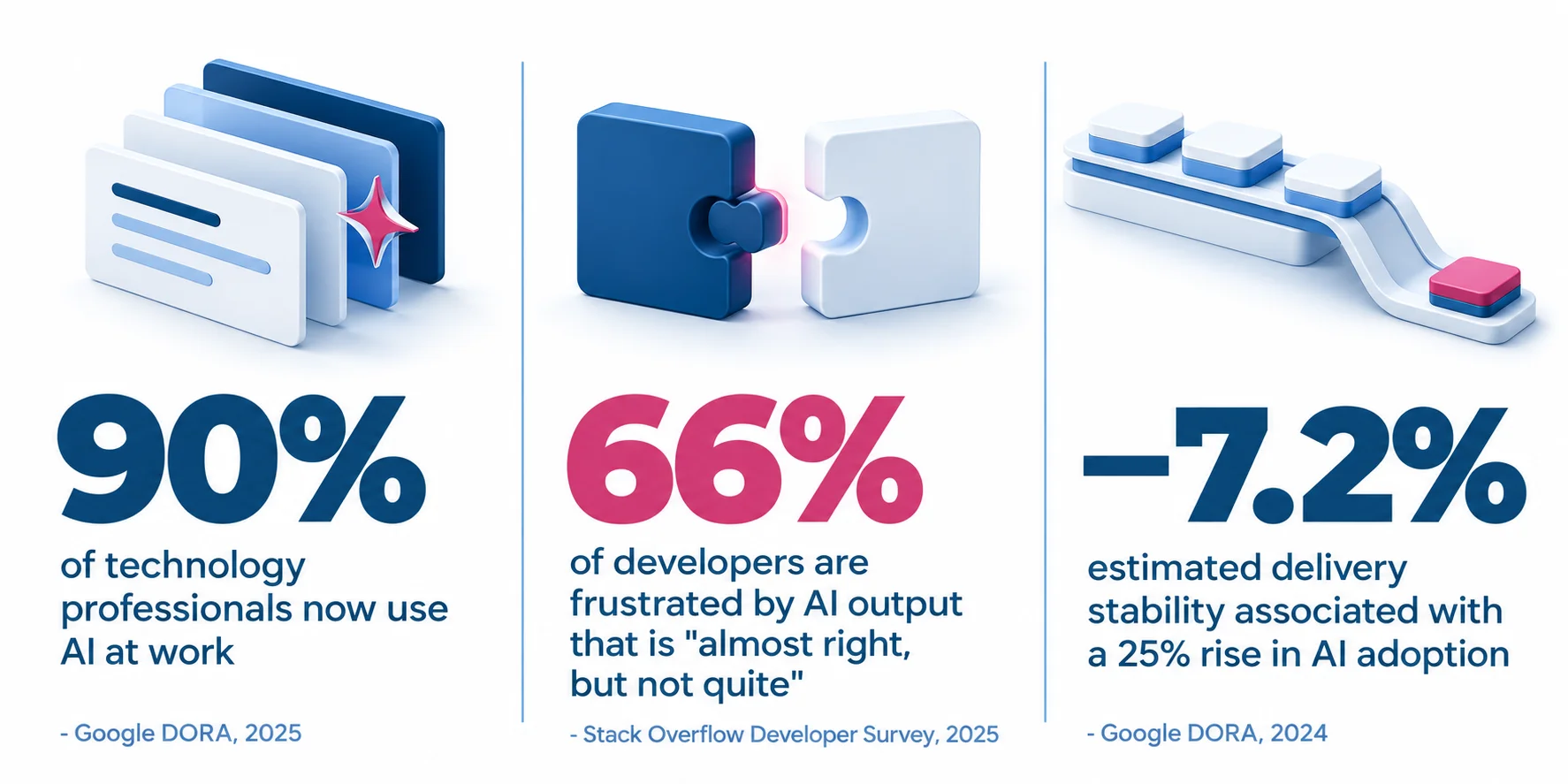
Here are the eight ways meaning disappears. Score each one honestly.
For each pattern, score 0 if you rarely see it, 1 if it happens sometimes, 2 if it happens often. Add up your total at the end.
Patterns 1-8
| Pattern | What it sounds like and how it is closed | Score |
|---|---|---|
| 1. Ageing Requirements · Test |
CSounds like: “The policy changed last month, but the agent pulled the old rule – and the tests passed.” Closed by: Versioned context, with an owner and an expiry date on every rule. |
Score 0 1 2 |
| 2. Omission Requirements → Design |
Sounds like: “The ability-to-pay check was agreed in a meeting. It never made it into the story.” Closed by: A validator that checks every story against domain rules before design starts. |
Score 0 1 2 |
| 3. Substitution Design · Development |
Sounds like: “The agent picked a pattern that looks right. It isn’t on our approved list.” Closed by: Context drawn only from authoritative sources; designs checked against your architecture catalogue. |
Score 0 1 2 |
| 4. Translation Every hand-off |
Sounds like: ““Eligible customer” means one thing in the requirement, another in the code and a third in the test data.” Closed by: Requirements traced to design, code, tests and controls in one knowledge graph. |
Score 0 1 2 |
| 5. Fragmentation Design · Release |
Sounds like: “The decision is split across a ticket, a wiki page, a chat thread and an email. Nobody sees all of it.” Closed by: One integration layer across Jira, ADO, Git, wikis and ITSM – no new repository. |
Score 0 1 2 |
| 6. Access failure Vendor and partner boundaries |
Sounds like: “The eligibility flag lives in the partner-hosted core. The agent can’t reach it.” Closed by: Identity-aware retrieval, with third-party gaps recorded as residual risk instead of ignored. |
Score 0 1 2 |
| 7. Compression loss Long programs · Multi-team hand-offs |
Sounds like: “The summary dropped “except for joint accounts.” Production found it.” Closed by: Hand-off records that keep decisions, exceptions, assumptions and open questions. |
Score 0 1 2 |
| 8. Contamination Any agent with tools |
Sounds like: “An instruction hidden in a pasted document changed what the agent did next.” Closed by: Provenance on every context element, least-privilege agents and explicit approval for consequential actions. |
Score 0 1 2 |
Your Score
| Total | What it means | Where to start |
|---|---|---|
| 0–4 Contained | Context mostly survives your hand-offs. You likely have strong documentation discipline and few vendor boundaries. | Keep AI agents bounded; measure stale-context and rework rates as adoption grows. |
| 5–9 Leaking | Agents are working from partial reality on some journeys. Expect rework and review load to rise with AI adoption. | Pick one journey with visible hand-offs and map where context is lost. |
| 10–16 Systemic | Tacit knowledge is carrying your delivery. AI will amplify the gaps faster than people can patch them. | Treat context as an engineered, governed asset before scaling agents further. |
Proof Point
What it looks like when context is reconstructed. At a global bank, undocumented tribal knowledge across roughly 1,000 legacy trading and client-facing screens was the single largest driver of migration cost and risk. Reconstructing application intent, rather than translating code line by line, cut per-screen effort by more than 80% and overall program effort by 30–50% without loosening audit control.See your highest-scoring pattern closed, live. Context.OSAI is the operating system for AI-native software delivery: a living Knowledge Fabric, agents at every SDLC stage and governance gates that keep every decision traceable. In a 45-minute live demo we run one delivery scenario end to end – no slides.
See your highest-scoring pattern closed, live.
Context.OSAI is the operating system for AI-native software delivery: a living Knowledge Fabric, agents at every SDLC stage and governance gates that keep every decision traceable. In a 45-minute live demo we run one delivery scenario end to end – no slides. Book A Demo
You have named the patterns. Now engineer them out.
Our whitepaper, The Context Continuum, sets out the operating model behind every "Closed by" line above, from versioned context and provenance to the governance gates that keep each decision traceable.
Read the whitepaper