

Part 2 of 2. A seven-gate test for moving AI from pilot to production in regional banks. Part 1 sets the operating model these gates sit inside.
The demo worked. The steering committee clapped. Eighteen months later, it’s still a demo.
Plenty of regional banks will recognize that timeline. A Wolf & Company survey from earlier this year found that every community bank it surveyed had adopted AI in some form. Only 25% had moved a proof of concept into production. Just 5% were running a scaled, governed AI program. The sample is small, 20 executives across 17 banks with $750 million to $25 billion in assets, so treat the numbers with care. Don’t ignore the shape.
Larger studies show the same shape. IDC, working with Lenovo, found that for every 33 AI proofs of concept launched, only four reached production. IDC pointed to low organizational readiness in “data, processes and IT infrastructure.” That research spans industries, and a stalled pilot in a bank sits closer to a regulator than one in a retailer.
Starting is easy. Finishing is where regional banks stall.
Large banks absorb a stalled pilot with a platform team and a validation group. Regional banks run lean. Wolf’s respondents named limited internal expertise (50%) and governance or operating model gaps (35%) among their top challenges, and 30% were still limited to ad hoc or vendor-embedded AI. A lean team can run a pilot. It struggles to run the sixth, seventh and eighth things a production system needs at the same time. That is why regional banks need a different AI operating model, not a smaller copy of a Tier 1 one.
AI pilot vs production: three jobs wearing one name
Banks tend to describe AI maturity as a single line from pilot to scale. It is three separate jobs, with different owners and different budgets.
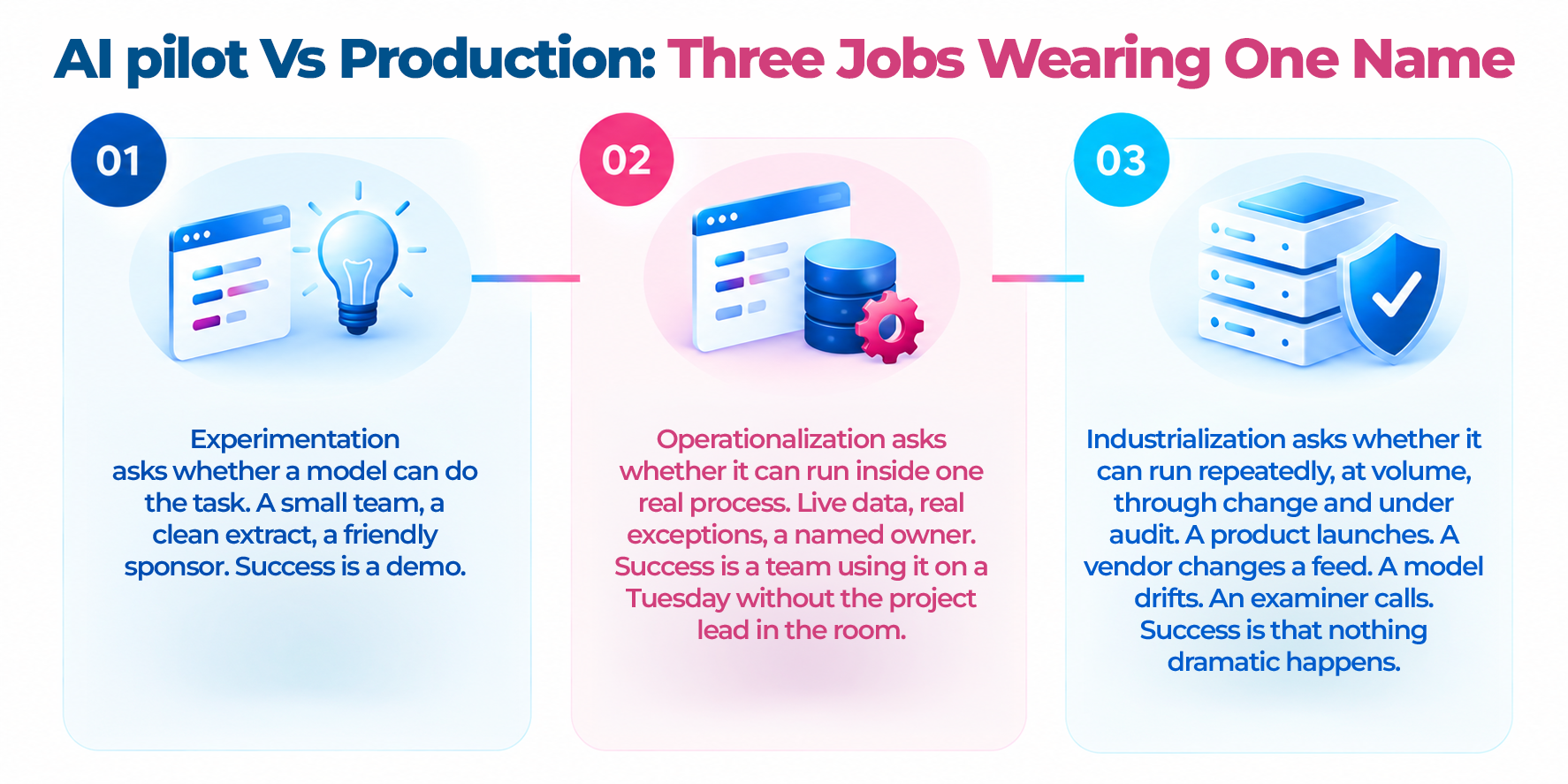
- Experimentation asks whether a model can do the task. A small team, a clean extract, a friendly sponsor. Success is a demo.
- Operationalization asks whether it can run inside one real process. Live data, real exceptions, a named owner. Success is a team using it on a Tuesday without the project lead in the room.
- Industrialization asks whether it can run repeatedly, at volume, through change and under audit. A product launches. A vendor changes a feed. A model drifts. An examiner calls. Success is that nothing dramatic happens.
Most regional banks can do the first. Many manage the second, once. The third barely has a budget line. Wolf’s data shows where the effort goes: 95% of surveyed banks use AI productivity tools for employees, 45% use AI in fraud, risk or compliance support, and 20% in marketing and personalization. The easy use cases ship first. The ones that touch a customer decision or a regulator are where pilots tend to stall.
Why bank AI pilots stall: the seven things a pilot hides
- Connected data. The pilot ran on an extract. Production needs governed, reconciled data from systems that disagree about what a customer is. Forty percent of Wolf’s respondents named data quality or availability as a top challenge.
- Workflow redesign. Drop a model into an unchanged process and you get a faster version of the same queue. McKinsey’s advice, as summarized in American Banker, is to concentrate on one to three high-value domains and redesign the workflow around them instead of spreading AI thin.
- System integration. The output has to land in the core, the loan origination system, the case manager. Few of those systems were built to take it. Integration is often where the schedule slips.
- Testing. A demo is tested for accuracy. A production system is tested for regression, edge cases, volume, and what happens when an upstream feed changes on a Friday. Maveric’s recent look at why regional banks are winning on AI and losing on QA shows how fast AI-assisted development outruns traditional test automation.
- Monitoring. Models drift, quietly. Nobody notices until the output is wrong at volume. The Federal Reserve’s SR 26-2 expects ongoing monitoring and outcome analysis, including for vendor models.
- Human oversight. A reviewer facing 400 alerts a day isn’t overseeing anything. Someone has to set the threshold, the escalation path and the authority to override. The design differs by business line. Retail decisions are high in volume and small in value, so the problem is sampling and explanation at scale. Commercial decisions are fewer and larger, so the problem is deciding where a person’s judgment is mandatory.
- Operational ownership. When it breaks at 2 a.m., whose phone rings? A sponsor isn’t an owner.
An illustration, not a client case. Picture a pilot that extracts covenant terms from commercial loan files. In the demo it reads two hundred curated files correctly. In production it meets scanned amendments, a file with three borrowers, and a core system that can’t accept the output without re-keying. Nobody owns the exceptions queue. Each failure is small. Together they close the project.
Gartner expects over 40% of agentic AI projects to be canceled by the end of 2027, and names escalating costs, unclear business value and inadequate risk controls as the causes. Read that list again. None of it is about model quality.
One wrinkle for governance. SR 26-2 says generative and agentic AI models are “not within the scope of this guidance“. Banks with $30 billion or less in assets are generally excluded too, unless their model exposure goes beyond traditional community banking. Neither fact lowers the bar. Supervisors still expect governance that fits the risk, and nobody is handing you a checklist for agents. Further reads:
- SR 26-2, the EU AI Act, and CFPB Circular 2026-03: What Actually Changed for Banks This Year
- From AI Assistants to Governed Autonomy in Banking
AI production readiness: Seven gates before you scale
Turn the dependencies into a test. Before a use case gets scale-up funding, it shows evidence on each gate.
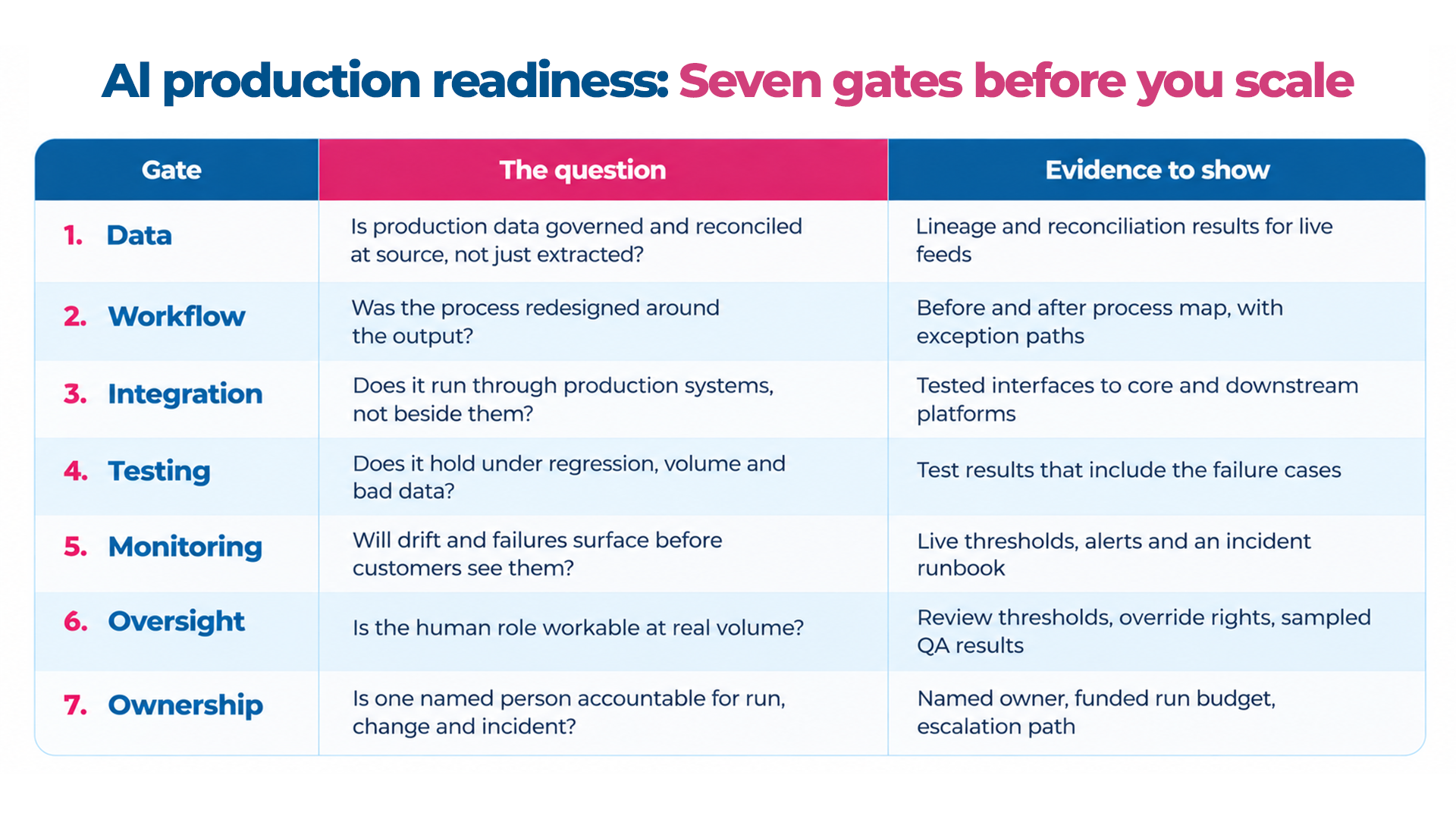
Score each gate red, amber or green. Any red stops the scale-up. Amber needs a dated plan and a named owner. Green needs a document you could hand to an examiner. Which use cases get tested, and how hard, is an operating-model decision. Part 1 covers how to choose three to five and tier the governance.
Run the test at the end of the pilot, before anyone has promised the board a date. It has a useful side effect. It shows you which pilots are demos with a sponsor. Kill those early. That’s cheap. Funding a failed scale-up is not.
Where a banking specialist closes the production gap
The gap between AI ambition and production doesn’t sit in one layer. It spans data, core platforms, application engineering, banking processes and quality engineering. Most vendors cover one of them. A model vendor ends at the model. A generalist integrator can staff the work but has to learn the bank’s operating reality on your budget.
Maveric is a banking-only technology specialist with 25 years inside those layers, and ten of the top thirty regional banks already run on its delivery. The work maps to the gates. Data engineering and modernization address gates one and three. PULSEAI, Maveric’s continuous quality intelligence platform, supports testing and quality monitoring in gates four and five. PRISMAI handles policy-driven decisions that need executable rules and an explainability log, with humans in the loop when policy is converted to rules and when deployment is approved. That supports gate six. EdgeOpsAI, for SRE and incident automation, supports the run ownership in gate seven. The AI@Scale Methodology runs the whole path, from business re-visioning to governed, audited deployment.
The model is the smallest part of the system. The rest is the bank.
Pick your three live pilots. For each, answer one question: who owns it at 2 a.m.? If you can’t name a person, you’ve found your industrialization problem, and a better model won’t fix it. The governance side of this, including how to engineer evidence before autonomy expands, is covered in Paper 3 and Paper 4 of our CIO Mandate Series.
Start with the choices these gates sit inside: Why Regional and Community Banks Need a Different AI Operating Model.
FAQs: Moving AI from pilot to production in banking
What is the difference between an AI pilot and a production AI system in a bank?
A pilot proves a model can do a task, usually with a small team and a clean data extract. A production system runs inside a real process on live data, with integration, testing, monitoring, human oversight and a named owner. Industrialization adds repeatability at volume, through change and under audit.
Why do so many bank AI pilots never reach production?
Mostly readiness, not model quality. IDC found that only four of every 33 AI proofs of concept reached production and pointed to weak organizational readiness in data, processes and IT infrastructure. In Wolf & Company’s community bank survey, limited internal expertise (50%) and data quality or availability (40%) sat behind only security and data leakage (55%) among the top challenges.
Does SR 26-2 apply to regional and community banks?
The Federal Reserve says the guidance is expected to be most relevant to banking organizations with over $30 billion in total assets, and generally excludes those at or below that level unless their model exposure is significant. It also places generative and agentic AI outside its scope. Either way, supervisors expect governance that fits the bank’s size and risk.
What evidence should a bank have before scaling an AI use case?
Seven items: lineage and reconciliation of live data feeds, a redesigned process map, tested production integrations, test results that include failure cases, live monitoring thresholds with a runbook, defined human review rules, and a named owner with a funded run budget.
Who should own an AI use case after launch?
One named person accountable for run, change and incident response, with a funded run budget and an escalation path. The sponsor who championed the pilot is a different role from the operational owner who answers when it breaks.