


Regional banks are not behind on AI in software delivery. They are ahead. The real question is whether test automation moved with them.
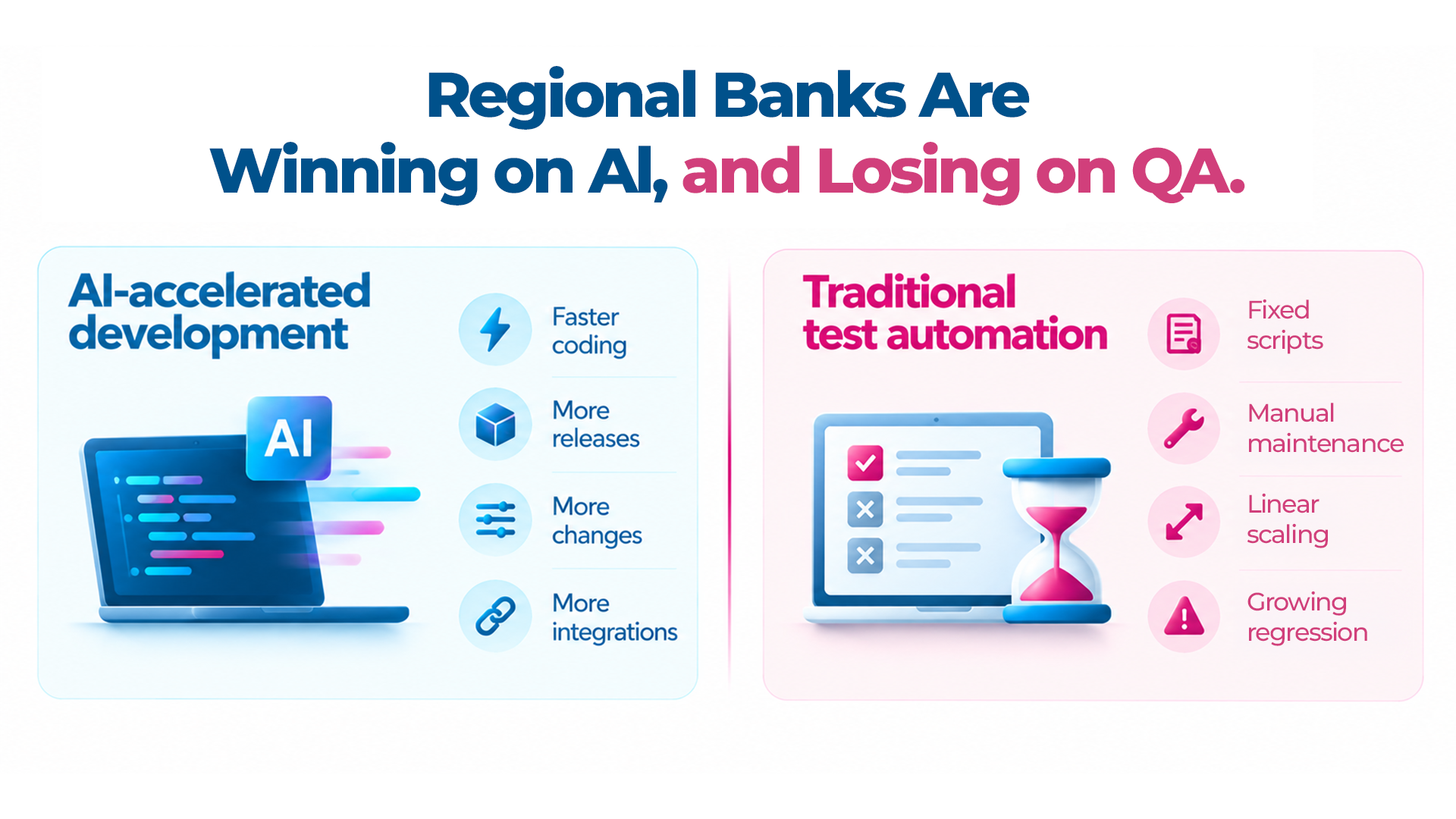
Most bank technology leaders have this backwards. The assumption, understandably, is that regional banks and credit unions are playing catch-up on AI, that megabanks with larger technology budgets are further along. The data says the opposite. Research from McKinsey found core regional banks moving faster than megabanks through the ideation and deployment stages of generative AI adoption, with fewer megabank use cases actually reaching full production. In one McKinsey case study, a regional bank saw developer productivity increase 40 percent after adopting generative AI in its coding workflow, and more than 80 percent of its engineers said the tools made their day-to-day coding better.
That is not a five-year-out prediction. It already happened, at institutions the size of most Tier 2 and Tier 3 banks. Which raises the question most technology roadmaps quietly skip: if development got 40 percent faster, did QA get 40 percent more capable over the same period? For most regional banks and credit unions, the honest answer is no.
Three Forces Compounding Right Now, Not in Three Years
It would be convenient if this were a future problem, something for next year’s budget cycle. It is not. Three forces are compounding inside the same institutions today.
Development velocity has already increased, and it keeps increasing as coding assistants mature and get embedded deeper into developer workflows. That is not a one-time bump. It is a new baseline pace, and it only creates value if release cycles speed up to match it. For most institutions, they have not, because QA keeps absorbing the extra throughput at the same pace it always ran at. The bottleneck simply moves further down the pipeline, from writing code to verifying it.
Real-time infrastructure is expanding the surface area that has to be tested under time pressure. FedNow and other instant-payment rails compress the testing window for anything touching payments from a batch-cycle timeframe down to same-day, sometimes same-hour, and agentic AI systems that do not just generate content but execute multi-step tasks on their own, is moving from experimentation to production faster than most governance frameworks planned for. FINRA added agentic AI as a named risk category in its 2026 Annual Regulatory Oversight Report for the first time, which is itself a signal that regulators see this as already underway, not hypothetical
What Traditional Test Automation in Banking Was Never Built to Absorb
Most test automation in banking today is a fixed, pre-written sequence. Someone writes the script once, and it runs unchanged until someone manually edits it. It does not reason about why a test exists or what risk it protects against, and when the application changes, the script breaks instead of adapting. None of this self-adjusts, so it scales linearly with effort: more releases and integrations mean proportionally more people writing and maintaining scripts, even inside a modern CI/CD pipeline where the deployment mechanics have already been automated but the test logic behind them has not. That is the mechanism behind a number that should concern any technology leader watching this trend: the cost of poor software quality runs to an estimated 2.41 trillion dollars annually, industry-wide, and for an individual institution, that gap often shows up as a quality blind spot covering a meaningful share of what actually needs testing but is not visible until something breaks.
A Change That Looks Simple. It Is Not.
Consider a scenario familiar to almost any SME lending team: adding a bullet repayment option, a single new feature that looks contained on paper. In practice, it touches product configuration, loan servicing calculations, origination workflows, and at least two or three downstream integrations that were not part of the original request. None of that is unusual. It is what simple changes actually look like inside a bank’s real system topology, and it is exactly the kind of dependency that a tribal-knowledge QA model catches late, if it catches it at all.
The Pressure Shows Up Differently by Segment
Tier 2 regional banks typically run the widest portfolio spread, core banking, digital channels, payments, lending, BSA/AML, fintech integrations, and regulatory reporting, often covered by one QA function working across all of them. Tier 3 and Tier 4 community banks are increasingly choosing best-of-breed overlay tools that sit alongside the existing core rather than committing to a multi-year platform replacement, which means any quality investment needs to deploy fast and work with what is already running. Credit unions most often run QA as a shared responsibility inside a broader IT role, one to three people rather than a dedicated function, even as a majority already have some form of AI adoption underway and prioritize fintech partnerships that expand what that compact team has to cover.
Where Maveric Fits
PULSEAI, Maveric’s continuous quality intelligence platform, is built specifically for this gap: connected knowledge, context-aware regression, and risk-based test design that scale with how fast a bank’s developers are already moving, without requiring a core platform replacement. The full campaign brief walks through what this looks like stage by stage, using the bullet repayment scenario above as a working example, along with segment-specific detail for regional banks, community banks, and credit unions.
Read the full brief here – Your Developers Already Sped Up. Did QA?
Worth asking honestly before your next planning cycle: what fraction of this year’s QA effort is spent maintaining scripts, versus actually reasoning about risk?