

Many banks have spent years expanding test automation. Yet release decisions can still involve lengthy reviews, oversized regression packs, manual impact analysis, and calls to the same subject matter experts.
That is not evidence that automation failed. It is evidence that the problem changed.
AI-first banking introduces faster change across increasingly connected systems. The quality challenge is no longer limited to test execution. It is deciding what to test, why it matters, how the evidence connects to business risk, and whether the bank can defend the decision to release.
Automation answers “how.” It does not always answer “what” or “why.”
In a conventional model, teams automate stable, repeatable scenarios. This reduces manual effort and supports CI/CD in banking. But four gaps often remain.
- Context gap. A script knows the steps it performs. It may not understand the product rule, customer consequence, or regulatory obligation behind them.
- Change gap. Static suites rarely explain which business processes and integrations a particular code or configuration change affects.
- Knowledge gap. Critical information may sit across requirements, test repositories, defect tools, operating procedures, and individual experience.
- Decision gap. Pass rates and test counts do not automatically show whether material release risk has been addressed.
Running more tests cannot compensate for uncertainty in test selection.
A banking change is rarely confined to one application
Consider a regional bank adding a bullet repayment option for an SME lending product. The feature may originate in loan origination, but its behavior can extend into servicing schedules, payments, delinquency treatment, collections, statements, accounting, and reporting.
A traditional approach may begin by asking teams to identify affected components, search past defects, and expand a regression pack. The quality of the answer depends heavily on who is in the room and what they remember.
An intelligence-led model begins with connected evidence. It relates the story to business processes, system dependencies, historical failures, existing tests, and applicable rules. AI can then support scenario generation and prioritization, while accountable specialists validate the output.
The difference is fundamental. Automation executes known instructions. Continuous Quality Intelligence improves how those instructions are formed.
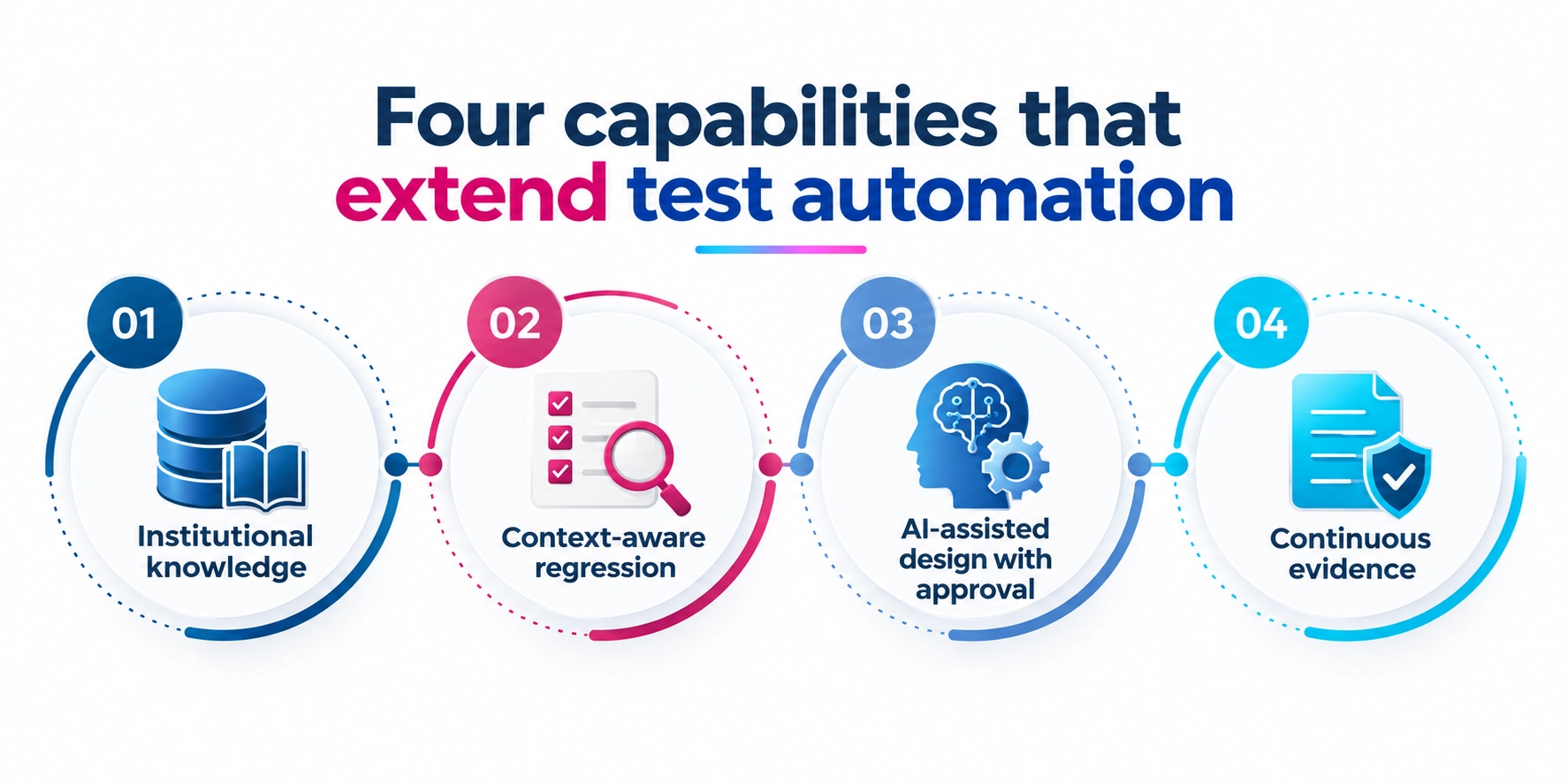
Four capabilities that extend test automation
1. Institutional knowledge
Banking knowledge must be available to the quality workflow, not trapped in disconnected files or individual memory. A governed knowledge layer can connect product documentation, business rules, test cases, process maps, and defect history.
2. Context-aware regression
Regression scope should reflect what changed, which dependencies are exposed, and where failure would matter most. This supports focused execution without treating every test as equally relevant.
3. AI-assisted design with approval
Generative AI can help refine acceptance criteria and develop positive, negative, boundary, integration, and risk-based scenarios. Human review is essential for banking-specific interpretation and accountability.
4. Continuous evidence
Quality signals should flow through CI/CD rather than appear only at a release gate. Leaders need traceability from requirement and risk to test, result, defect, and release decision
PULSEAI: beyond execution automation
Maveric PULSEAI brings these capabilities together in a banking-focused Continuous Quality Intelligence platform. Its hybrid Knowledge Fabric combines semantic retrieval and connected relationships. Its cognitive layer and quality engineering agents support contextual story assessment, impact and risk mapping, test design, regression planning, and defect intelligence. Low-code automation and hands-free execution help teams move from design to continuous validation within the toolchain they already use.
This does not make existing automation obsolete. It makes automation more relevant by grounding it in context.
For an AI-first bank, the mature question is not “How much have we automated?” It is “How much material risk can we understand, cover, and evidence before release?”
Why the operating model matters as much as the platform
Banks will not move beyond automation by introducing AI into the same disconnected workflow. If product owners, developers, testers, risk teams, and operations maintain separate interpretations of the change, generation simply creates more artifacts for people to reconcile.
A Continuous Quality Intelligence operating model establishes shared evidence and clear accountability. Product and business teams remain responsible for intent and acceptance criteria. Engineering teams provide architectural and change information. Quality specialists evaluate coverage and testability. Risk and control stakeholders define the situations that require additional scrutiny. AI supports these roles by retrieving context, identifying connections, and proposing outputs, but it does not erase ownership.
This division of responsibility is important for trusted AI in banking. A generated scenario should not progress because it sounds credible. It should progress because it is grounded in approved information, mapped to an identified requirement or risk, and accepted by an accountable reviewer.
The executive scorecard must evolve
An AI-first quality scorecard should balance efficiency with control. Useful measures include:
- Time from story readiness to approved test design
- Coverage of critical business and integration risks
- Regression tests selected because of demonstrated change impact
- Percentage of generated outputs refined or rejected by reviewers
- Automation maintenance effort and false-failure rates
- Escaped defects linked back to missing knowledge or coverage
- Time required to assemble release-readiness evidence
These metrics reveal whether the bank is improving its ability to reason about quality. They also make it harder for large automation inventories to conceal weak relevance or fragile assets.
The next stage of test automation banking is therefore not automation at any cost. It is intelligent automation that remains connected to business context and accountable decision-making.
Move from test automation to Continuous Quality Intelligence. Schedule a PULSEAI demo
FAQ
1. What is the difference between test automation and Continuous Quality Intelligence?
Test automation executes predefined checks. Continuous Quality Intelligence connects business context, change impact, risk, test design, execution, and historical evidence to support better quality and release decisions.
2. Does Continuous Quality Intelligence replace existing automation tools?
It should not require a wholesale replacement. Its role is to add contextual intelligence, governance, and orchestration around existing test management, automation, and CI/CD investments.
3. Why is this important for regional banks?
Regional banks must manage complex banking estates with leaner specialist teams. Reusable institutional knowledge and focused, risk-based regression can help them scale quality without scaling effort at the same rate.