

APIs changed core banking for the better. They helped banks break away from monolithic constraints, expose reusable services, and integrate digital channels with systems of record. For many institutions, API-led modernization became the practical foundation of digital banking. But the AI-first bank is beginning to expose a new limitation.
APIs are powerful, but they are still built around predefined constructs. A customer profile service returns a defined customer profile. A repayment service returns repayment data for a defined period. A transaction service returns a standard payload. Each service is reusable, reliable, and governed, but it usually serves every consumer in the same way. That worked well when the goal was digital access. It is less sufficient when the goal is decision intelligence. The next architecture shift in AI in banking is from service-level APIs to customer-level and transaction-level intelligence. The difference is not cosmetic. It changes the unit of banking architecture itself.
Dynamic Data Construction for Specific Contextual Decisions
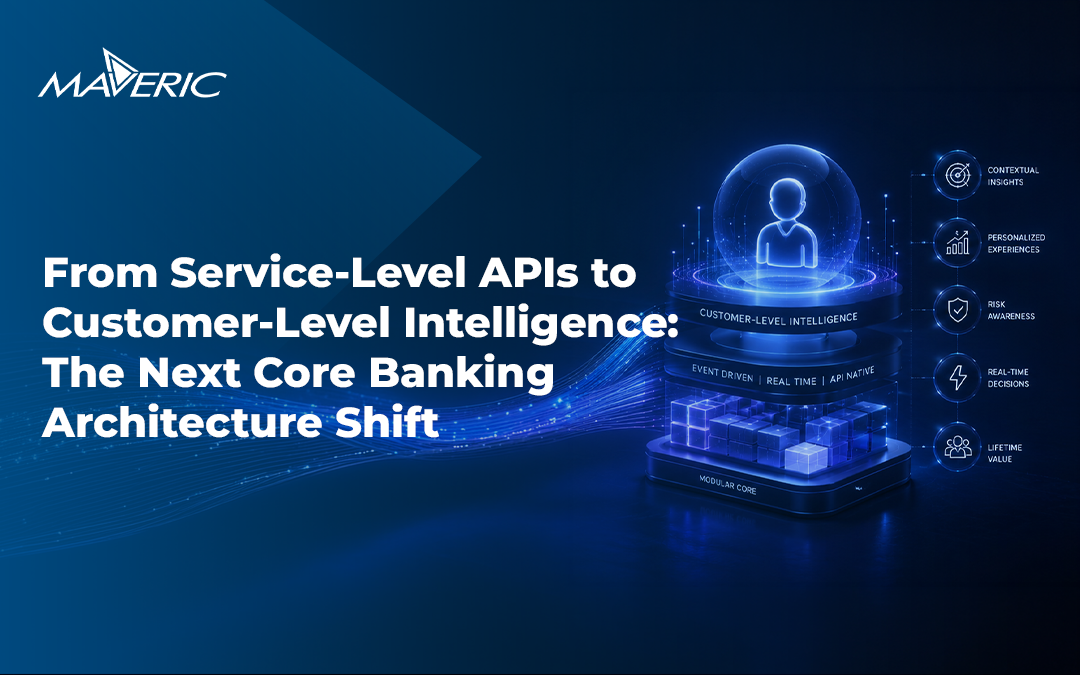
In the digital-first era, the service was the atomic unit. If a system needed customer data, it called a customer service. If it needed repayment information, it called a repayment service. If the business needed a new view, technology teams created a new service, report, or data mart. This model created scale, but it also created a ceiling. The bank could only ask questions that had effectively been answered in advance. The service had to exist. The report had to be designed. The data mart had to be engineered. Anything outside that predefined construct became a new technology requirement. AI changes this pattern through what the whitepaper calls agentic context assembly. Instead of calling a fixed service and accepting a fixed payload, an AI-enabled architecture can dynamically construct the data context required for a specific decision. It can identify relevant sources, combine structured and unstructured inputs, and assemble intelligence for one customer, one transaction, and one moment in time.
For a lending decision, this means the system does not simply retrieve a generic customer profile. It can assemble repayment history, current account behaviour, recent customer interactions, and relevant document content into a decision-specific context. The output is not a general-purpose data view. It is intelligence shaped around the lending decision at hand. For fraud detection, the shift is equally important. A predefined service may expose transaction values, counterparty details, and account information. But an AI-first architecture can reason over the broader transaction context, including behavioural patterns and narrative content that a conventional service may not have been designed to surface. The bank moves from retrieving data to understanding context.
CIO Implications for Banking Transformation Decisions
This is why AI-first banking should not be understood as a faster version of digital banking. It is a more granular version of banking intelligence. The service-level model delivers the same data payload to every consumer. The AI-first model generates a different assembly of intelligence for every decision context. For CIOs, this has important implications for banking transformation strategy. First, API modernization remains necessary, but it is no longer the end state. APIs provide access and integration. The intelligence layer above them determines how data is assembled, validated, interpreted, and governed.
Second, the data surface must expand. Traditional services largely operate on structured fields: dates, values, categories, balances, and statuses. AI-enabled decisioning can also reason over the meaning inside text columns, documents, transaction narratives, compliance notes, and manual override explanations. This makes unstructured data part of the banking decision surface. Third, governance must move with the logic. In a service-led architecture, governance lived largely at the API and service level. In an AI-enabled architecture, the decision logic increasingly lives in prompts, context specifications, validation rules, and agentic workflows. These must become governed artefacts, with versioning, lineage, exception handling, and auditability.
Conclusion
The practical lesson is clear. Banks should not think of AI as something that merely consumes API outputs. AI changes what those outputs are for. It enables the core to move from standardized access to contextual intelligence. That is the real promise of AI-enabled core banking: not replacing APIs but extending the architecture beyond service-level access into decision-specific intelligence.
The next core banking architecture will still need services. But the competitive advantage will come from what sits above them, the intelligence layer that can assemble the right context for the right decision, at the right moment.
FAQ
1. What is the limitation of service-level APIs in core banking?
Service-level APIs usually return predefined data payloads. They are effective for access and integration, but they are limited when a decision requires a context that was not already engineered into a service, report, or data mart.
2. What is customer-level intelligence in banking?
Customer-level intelligence is the ability to assemble decision-specific context for an individual customer at a specific moment. It goes beyond a generic customer profile by combining relevant structured and unstructured signals for the decision being made.
3. How does AI change core banking architecture?
AI changes core banking architecture by moving the atomic unit from the predefined service to the specific context. Instead of relying only on fixed APIs, AI can dynamically assemble the information needed for a particular customer, transaction, or decision.
4. What is agentic context assembly?
Agentic context assembly is the AI-driven capability to identify relevant data sources, combine structured and unstructured inputs, and create a decision-specific data context on demand.
5. Do AI-first banks still need APIs?
Yes. APIs remain essential for integration and access. However, in an AI-first core, the intelligence layer above the APIs becomes equally important because it assembles, validates, interprets, and governs decision-specific context.
Download The CIO’s Guide to AI-Enabled Core Banking Modernisation whitepaper to know more about how banks can stay prepared for this shift.