


Banking modernization is often framed as a choice between two uncomfortable extremes: continue carrying the constraints of a legacy monolith, or accept the cost and risk of replacing the core.
That framing misses a third path. A bank can progressively move high-change capabilities out of the monolith while the core continues doing what it already does reliably: processing transactions.
The Strangler-Fig pattern provides the architecture for that transition. New bounded contexts are built alongside the legacy estate, a stable façade routes traffic between old and new implementations, and functionality moves only when the new service
Modernization From the Outside In
The principle is straightforward. Do not begin by dismantling the core. Begin at the edges where change is frequent, integration cost is high and the business boundary can be defined cleanly.
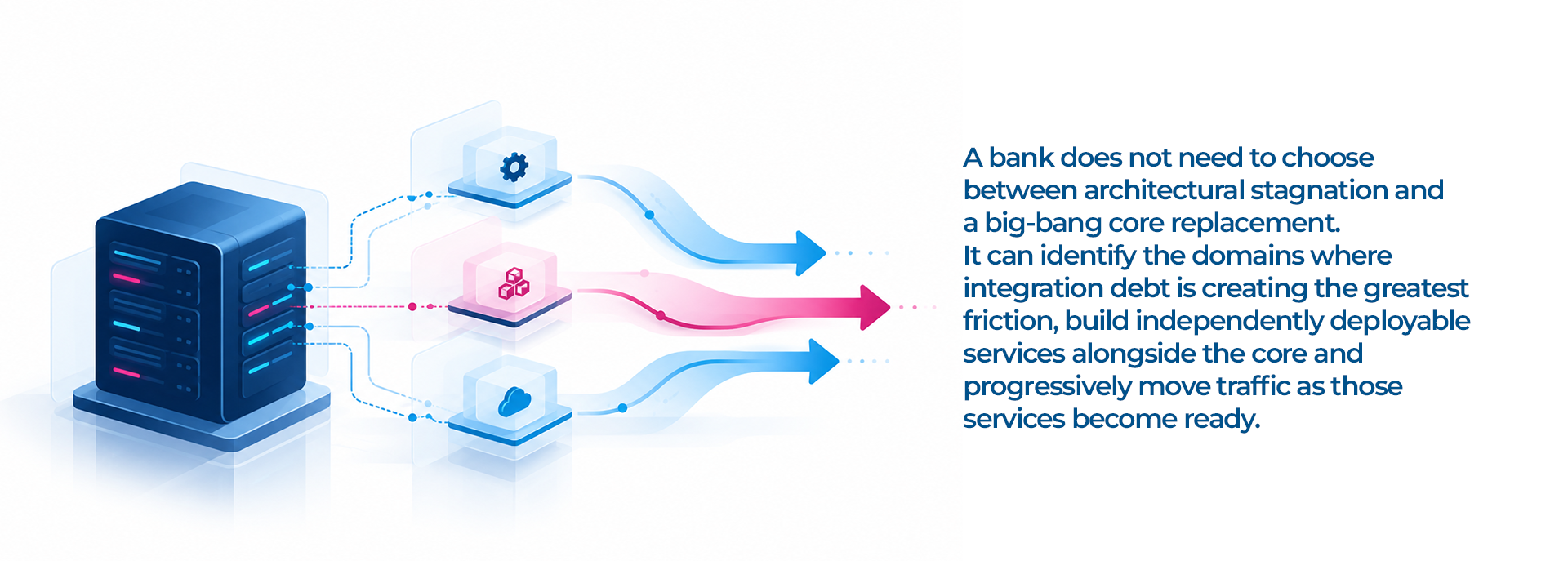
Each new bounded context has its own data model, APIs and deployment pipeline. The legacy core continues processing the functions that remain inside it. As the new service matures, traffic is progressively routed away from the legacy implementation.
This approach contains change. It also creates a sequence of production decisions rather than a single migration event. For a Tier 2 or regional bank, that matters because the institution can target architecture investment at the parts of the estate generating the most delivery friction without putting the entire transaction platform into motion at once.
The Façade Is a Control Point, Not Just a Router
The Strangler-Fig pattern depends on a stable, governed façade. In banking, that layer has to do more than direct traffic. It must support versioning, consent management, rate limiting, security policy enforcement and observability while serving both legacy and new services during the transition.
If the façade becomes another opaque dependency, the bank simply creates a new concentration point. Deliberate gateway design is therefore part of the modernization architecture, not an implementation detail.
This is especially important when services have different release cycles and regulatory obligations. The routing layer has to preserve continuity while allowing new bounded contexts to evolve independently.
Where Should a Bank Start?
Not every domain offers the same return on decomposition. Maveric’s technical briefing identifies five entry points that consistently provide strong architecture value in Tier 2 and regional banking environments because they combine high consumption, frequent change and relatively clear separation from core transaction processing.
Customer identity and profile can serve multiple channels through a reusable service rather than repeated core integration. Payment initiation and status can separate routing, validation, consent and status reporting from settlement. Product and account origination can consolidate the 8 to 15 bespoke integrations that typically span KYC, credit decisioning, document collection, identity verification and provisioning. Notifications can move from batch-oriented coupling to event-driven delivery. Regulatory reporting can replace bespoke extracts with governed, versioned, audit-ready feeds.
The right first domain is therefore not necessarily the largest. It is the bounded context where decomposition can remove the greatest recurring integration burden while keeping the transaction core stable.
Domain Knowledge Changes the Delivery Economics
The architecture pattern itself is well established. The harder part in banking is encoding the domain knowledge required to make it production-ready.
A payment initiation service for a UK bank has to account for Faster Payments message formats, PSD2 consent models, FCA strong customer authentication requirements, CHAPS settlement windows and the bank’s own core data model. Customer and KYC services carry their own CDD, EDD, beneficial ownership and GDPR requirements. Compliance services need audit trails and regulatory evidence.
When that knowledge has to be rediscovered during each modernization programme, the architecture may be sound while delivery remains slow. The briefing therefore places particular emphasis on reusable banking API libraries, regulatory bundles and reference architectures as a way of avoiding repeated domain reconstruction.
Operational Resilience Becomes an Architecture Property
The modernization case is also increasingly connected to resilience. The briefing highlights ICT dependency mapping, resilience testing and incident reporting as architecture-relevant obligations under the UK operational resilience environment and, where applicable, DORA.
Undocumented point-to-point integrations make dependency mapping difficult. Tightly coupled monoliths make isolated testing harder. Event-driven services can provide structured audit trails and event logs that support incident reporting.
This is an important shift in how modernization value should be assessed. Service boundaries are not only about delivery velocity. They can also make dependencies more visible, testing more targeted and compliance evidence more continuous.
The Core Does Not Have to Move First
A bank does not need to choose between architectural stagnation and a big-bang core replacement. It can identify the domains where integration debt is creating the greatest friction, build independently deployable services alongside the core and progressively move traffic as those services become ready.
That requires discipline: clear bounded contexts, a governed façade, domain-specific API design, observability, security and a realistic understanding of the production estate as it operates today.
But it changes the modernization risk equation. The core keeps running. The bank modernizes the parts of the architecture that make change expensive. And each successful decomposition creates a reusable capability that reduces the cost of what comes next.
Download the Technical Briefing
The Hidden Cost of Monolithic Banking provides the deeper architecture view behind this approach. It examines why point-to-point integration debt can be a greater constraint than the core itself, how the Strangler-Fig pattern works in a live banking environment, and which five bounded contexts can provide the strongest modernization entry points.
It also covers banking-domain reusable IP, security, compliance and operational resilience considerations for UK institutions evaluating API-led decomposition.
Download The Hidden Cost of Monolithic Banking
FAQ
1. What is the Strangler-Fig pattern in banking?
It is an incremental modernization approach in which new domain services are built alongside the legacy core and traffic is progressively moved to them through a governed façade as they become production-ready.
2. Which banking domains can be good starting points for decomposition?
The briefing identifies customer identity and profile, payment initiation and status, product and account origination, notifications and communications, and regulatory reporting and compliance data.
3. Does API-led decomposition require replacing the core?
No. The approach described in the briefing keeps the legacy core running while selected capabilities are extracted into independently deployable services around it.