

For more than a decade, legacy core banking systems have carried much of the blame for slow releases, expensive change and fragile technology estates. The conventional answer has been equally familiar: replace the core with a modern, cloud-native platform and remove the constraint at its source.
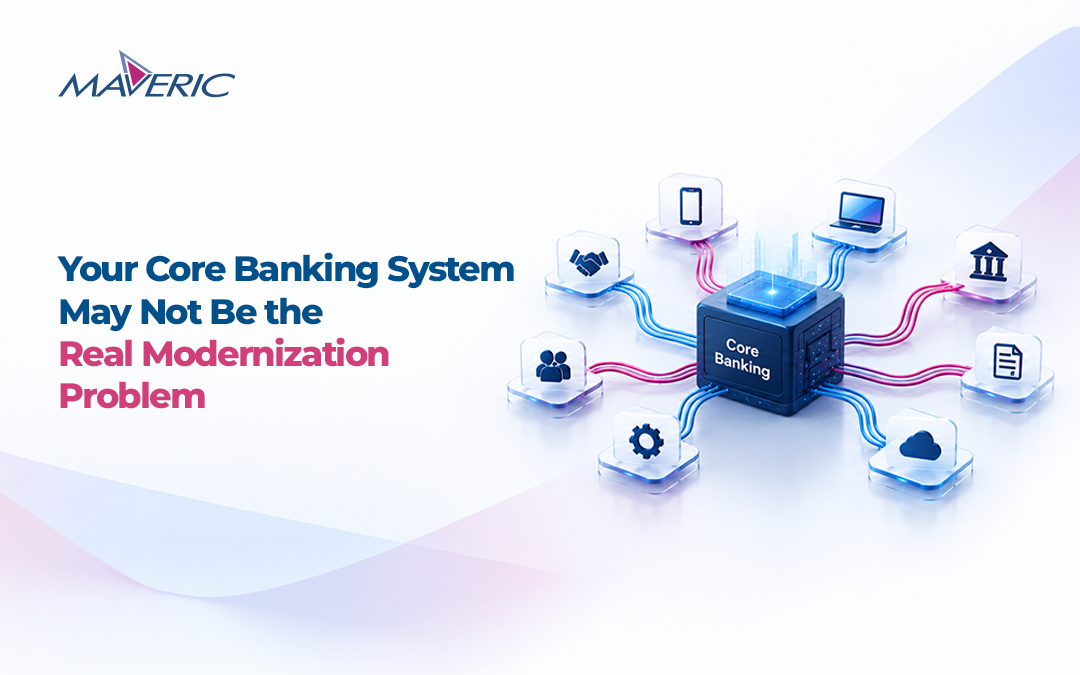
But for many UK Tier 2 and regional banks, that diagnosis can be incomplete. The core may still process transactions reliably. The deeper constraint is often the integration model wrapped around it: years of point-to-point connections, bespoke middleware and channel-specific interfaces that make every change touch more of the estate than it should.
That distinction matters because it changes the modernization question. Instead of asking how quickly the bank can replace the core, architecture leaders should first ask what actually makes the core difficult to change around.
The Hidden Cost Is in the Integration Fabric

A monolithic banking estate becomes expensive not simply because the core is old, but because new capabilities repeatedly require custom connections back into it. A new channel becomes an integration project. A fintech connection becomes a programme. A release carries wider system risk because change cannot be cleanly contained.
The result is integration debt: an estate in which the cost of change compounds over time. The technical briefing The Hidden Cost of Monolithic Banking puts the impact in operational terms. In a typical Tier 2 bank with a monolithic integration model, launching a new product can take 6 to 18 months. The paper also cites legacy maintenance consuming 24% of IT budgets and points to potential IT cost reductions of 30 to 50% when point-to-point integrations are replaced with a unified, reusable API layer and cloud-native architecture.
For a CIO or chief architect, these are not merely architecture metrics. They describe how much transformation capacity is being absorbed before the bank can even begin differentiating through new products, channels or partnerships.
Why Core Replacement Can Be the Wrong First Move
Core replacement is one of the highest-risk and longest-duration technology programmes a bank can undertake. The briefing argues that successful transformations have typically depended either on greenfield models or years-long phased migrations backed by substantial programme budgets.
That does not mean the core should never change. It means the bank should separate two questions that are often collapsed into one: what must be modernized now, and what can continue performing its existing role while the surrounding architecture changes?
If the core remains a reliable transaction processor, replacing it first may force the bank to absorb significant migration risk before resolving the integration patterns that make delivery slow. A more targeted strategy is to decompose the integration model, build new services alongside the core and progressively reduce the number of consumers that need to understand legacy data structures and transaction models.
Modernization Should Reduce the Cost of the Next Change
This is where API-led domain decomposition becomes materially different from cosmetic modernization. The objective is not to make the architecture diagram look more modern. It is to change the economics of every subsequent release.
A reusable customer identity service, for example, can give mobile, web, branch, partner and regulatory consumers a stable domain interface rather than requiring each to integrate separately with the core. A payment initiation service can separate channel experience from settlement processing. An origination domain can consolidate the many bespoke integrations involved in KYC, credit decisioning, document collection, identity verification and account provisioning.
The architectural value is cumulative. Each bounded context extracted from the monolith reduces the surface area of future change and creates a service that can be reused rather than rebuilt for the next channel.
The CIO Decision Is About Containing Change
For UK regional banks, the practical modernization challenge is rarely a shortage of technology options. It is choosing an approach that improves delivery velocity without creating an unacceptable level of operational disruption.
That makes containment a useful test of architecture strategy. Can a new capability be changed independently? Can a service be tested without destabilizing unrelated functions? Can a new partner consume a governed API rather than trigger another bespoke core integration? Can the bank map the technology supporting an important business service with sufficient clarity for resilience obligations?
If the answer remains no, the architecture may have new components without having removed the underlying coupling.
Modernize the Constraint, Not the Diagram
The central modernization decision is therefore more precise than “replace or retain the core.” It is to identify where integration debt is constraining the bank today and progressively create domain boundaries that allow change to happen safely around the core.
For architecture and digital engineering leaders, this reframes modernization from a multi-year replacement event into a sequence of controlled architectural decisions. The core keeps processing what it processes well. New capabilities are built alongside it. Traffic moves only when the new services are production-ready.
That is a very different risk profile from a big-bang transformation – and a more useful starting point for banks whose immediate problem is not transaction processing, but the cost and fragility of changing everything around it.
Download the Technical Briefing
The Hidden Cost of Monolithic Banking examines why the integration model around the core can be the real modernization bottleneck, why conventional API layering often leaves the underlying debt intact, and how API-led domain decomposition can create independently deployable banking services without disrupting core transaction processing.
The briefing also sets out five high-ROI decomposition entry points for Tier 2 and regional banks, the role of the Strangler-Fig pattern, and the architecture implications of operational resilience and regulatory evidence.
Download The Hidden Cost of Monolithic Banking
FAQ
1. Is the legacy core always the main barrier to banking modernization?
Not necessarily. The briefing argues that the integration model around the core – including point-to-point integrations, bespoke middleware and channel connectors – can be the more immediate constraint on change.
2. What is integration debt in banking?
Integration debt is the accumulated complexity created when channels, partners and systems are connected through bespoke point-to-point logic that must be maintained and changed repeatedly.
3. What is API-led domain decomposition?
It is an approach that extracts bounded banking capabilities into independently deployable domain services with governed APIs, allowing the core to continue processing while new services are built alongside it.