



Every CIO and CTO eventually asks the same question: is closing the regression testing gap worth budgeting for. Here is the honest math.
Closing the gap between how fast a bank’s developers now move and how fast its QA function can verify what they build is, at some point, a budget conversation. Before that conversation happens, it is worth running the numbers on what the status quo already costs, whether or not that cost currently appears on a line item.
What Doing Nothing Actually Costs
Enterprise incident-cost research puts a typical significant outage between 100,000 and 300,000 dollars once emergency engineering time, incident response, and remediation are counted, according to ITIC’s 2025 Outage Cost Survey. Across financial services specifically, research from Splunk and Oxford Economics puts annual downtime cost at 152 million dollars industry-wide. Most of that figure never shows up as a planned line item. It shows up as engineering hours nobody budgeted for, absorbed quietly into whichever team is closest to the incident.
Run the same math on QA headcount instead of outages. A QA engineer earning a representative 110,000 dollars who spends 30 percent of their time maintaining scripts that break every time the interface changes is costing roughly 33,000 dollars a year in work that does not reduce risk, it simply keeps existing coverage from silently degrading. A five-person QA team spending that same share of its time on script maintenance represents close to 165,000 dollars a year not spent on the judgment calls that actually catch defects before release. That number exists inside the budget whether or not anyone has isolated it.
What Closing the Gap Is Worth
The opportunity here is not simply more testing. It is more useful testing, concentrated where risk actually lives instead of spread evenly across everything a team happens to have time for. Applied to that same representative QA salary base, a 35 percent reduction in testing cost on a five-person team is worth roughly 58,000 dollars a year back, available to redirect toward the highest-risk share of changes instead of toward script maintenance that scales with headcount, not with how quickly development moves.
Three Paths, and What Each One Actually Costs
Every technology leader in this position eventually chooses between three paths for regression testing and release management in banking, and it is worth being honest about what each one buys and what it costs beyond the sticker price.
- Do nothing: no near-term budget ask, but the gap between development velocity and QA capacity widens every sprint, and defect leakage and release delays compound quietly in the background.
- Add QA headcount: coverage grows roughly in proportion to hires, but cost scales linearly with change volume, the same trap that makes scripted automation expensive in the first place, now with people instead of scripts.
- Adopt connected, risk-aware quality engineering: coverage and speed improve together without linear headcount growth, though it requires a genuine shift from scripted to intelligent tooling, not a simple plug-in.
The middle path, adding headcount reactively, is the one most institutions default to without deciding to. A hire here, a contractor there, in response to whatever broke most recently. It feels lower-risk because each individual hire is a small decision. Over several years, though, it is often the most expensive path on the table, because the underlying inefficiency, linear effort scaling against exponential system complexity, never actually gets fixed. It just gets staffed around, until the next budget cycle forces the question again. A bank with roughly two billion dollars in assets might add two QA hires this way over three years and still not close the gap, because two people cannot out-scale linear growth in system complexity.
What the Numbers Look Like When the Gap Closes
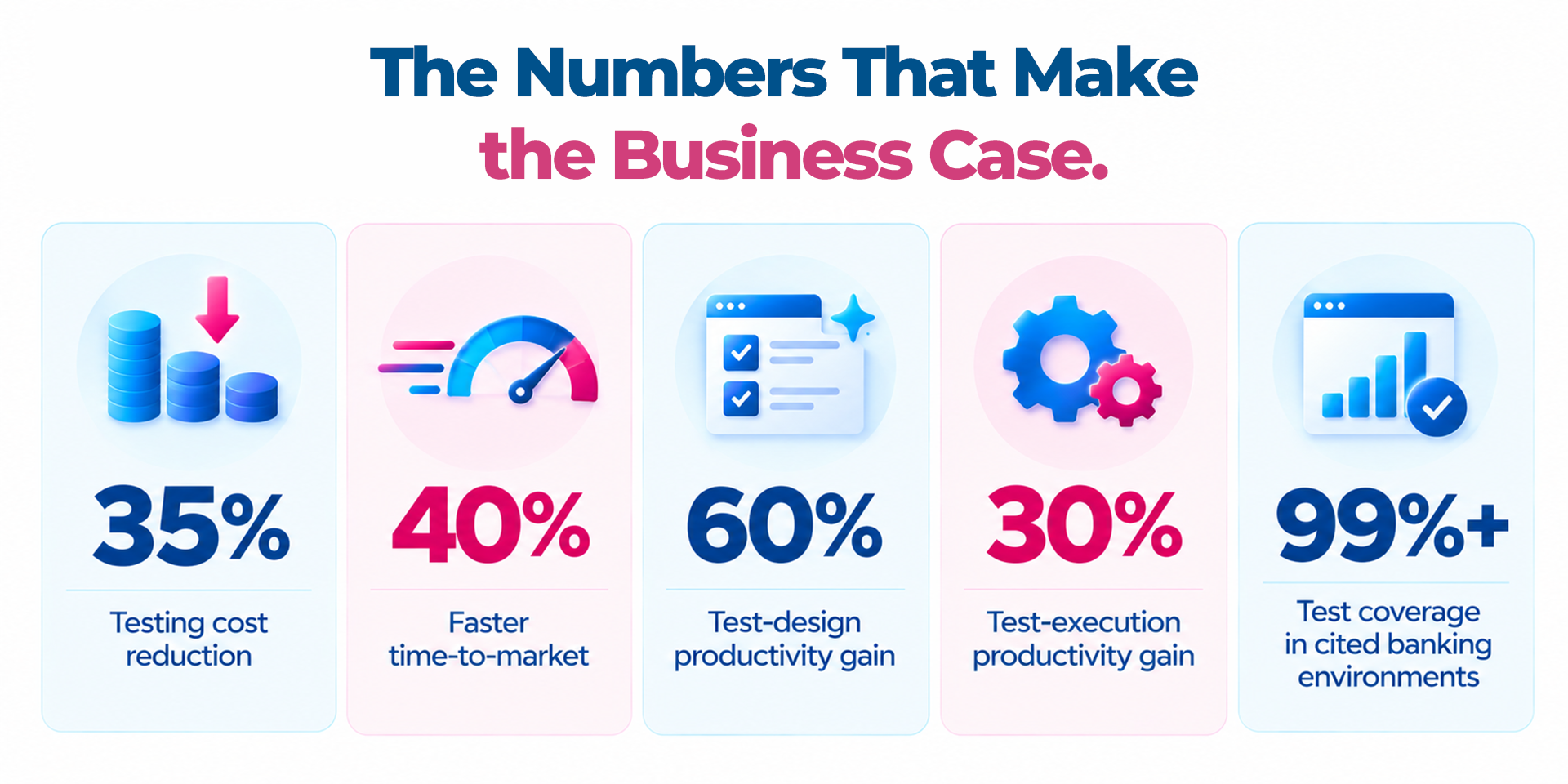
Platforms built on connected knowledge, risk-based prioritization, and human-governed AI output are already delivering measurable results in banking environments: test coverage moving from roughly 70 percent to over 99 percent, testing costs down 35 percent, time-to-market 40 percent faster, and support costs down 20 percent. Within test design and execution specifically, productivity gains run close to 60 percent in design and 30 percent in execution, a gap that makes sense given that test design used to be almost entirely manual analysis while execution was already partially automated in most environments.
None of this requires replacing a bank’s core platform or existing test management tooling. It requires treating quality engineering as something that reasons about the system, instead of something that only executes instructions written for a version of the system that stopped existing a while ago.
What This Is Not
This is not a plan to reduce QA headcount. The gap described here was never too many people. It is too much manual, repetitive work absorbing time that should go toward judgment calls a system cannot make. And it is not a black box making unaccountable decisions: every AI-generated test, every risk score, and every prioritization call is visible and requires human sign-off before it acts on anything, which matters as much for an internal auditor’s question as it does for an examiner’s.
Where Maveric Fits
PULSEAI, Maveric’s continuous quality intelligence platform, is the mechanism behind the coverage, cost, and time-to-market figures above. The full executive brief walks through this math in more detail, including a comparison of the three paths against a representative cost base, and closes with an offer to run the same categories against a bank’s own numbers.
Read the full executive brief here.
Worth asking honestly in the next budget cycle: what would it cost, in dollars, if the quality gap your organization is currently absorbing quietly showed up in a single production incident instead?
Sources
ITIC, 2025 Outage Cost Survey. Splunk and Oxford Economics, “Hidden Costs of Downtime” research. McKinsey and Company, “Regional banks branch out with AI.” QA salary and cost figures are illustrative, calculated from a representative 110,000 dollar base, not a specific client’s reported numbers. Live citation links to be attached before publishing.