

AI in banking is changing more than customer service, fraud detection, and decisioning. It is also changing how banking software is conceived, built, and released. Requirements can be refined faster. Code can be generated sooner. Delivery teams can push more changes through the pipeline.
For bank technology leaders, that creates a less visible question: can quality engineering absorb the additional volume and variability without increasing production risk?
Google Cloud’s 2025 DORA research found AI adoption among software development professionals had reached 90 percent, while 80 percent reported productivity gains. The same research frames AI as an amplifier of the delivery system around it. Strong systems gain leverage; weak systems expose their constraints faster.
In banking, quality engineering is often that constraint.
Faster development expands the assurance problem
Traditional quality models assume that teams have enough time to interpret a requirement, consult subject matter experts, identify affected systems, design tests, update automation, execute regression, and review results. AI compresses the activities upstream, but it does not remove the need for judgment downstream.
A change to an SME lending repayment option may appear local in a backlog. In practice, it can affect product configuration, origination, servicing, payments, collections, customer communications, reporting, and controls. Generating code faster does not make those relationships simpler. It increases the speed at which an incomplete understanding can reach production.
This matters acutely for regional banks. They often operate mixed estates that combine legacy cores, packaged banking platforms, digital channels, third-party services, and internally developed applications. Their teams may also depend on a small number of specialists who understand how business rules and systems interact.
Why more automation is not a complete answer
Test automation improves repeatability and execution speed. It remains essential. But an automated test can run quickly and still be the wrong test for the change.
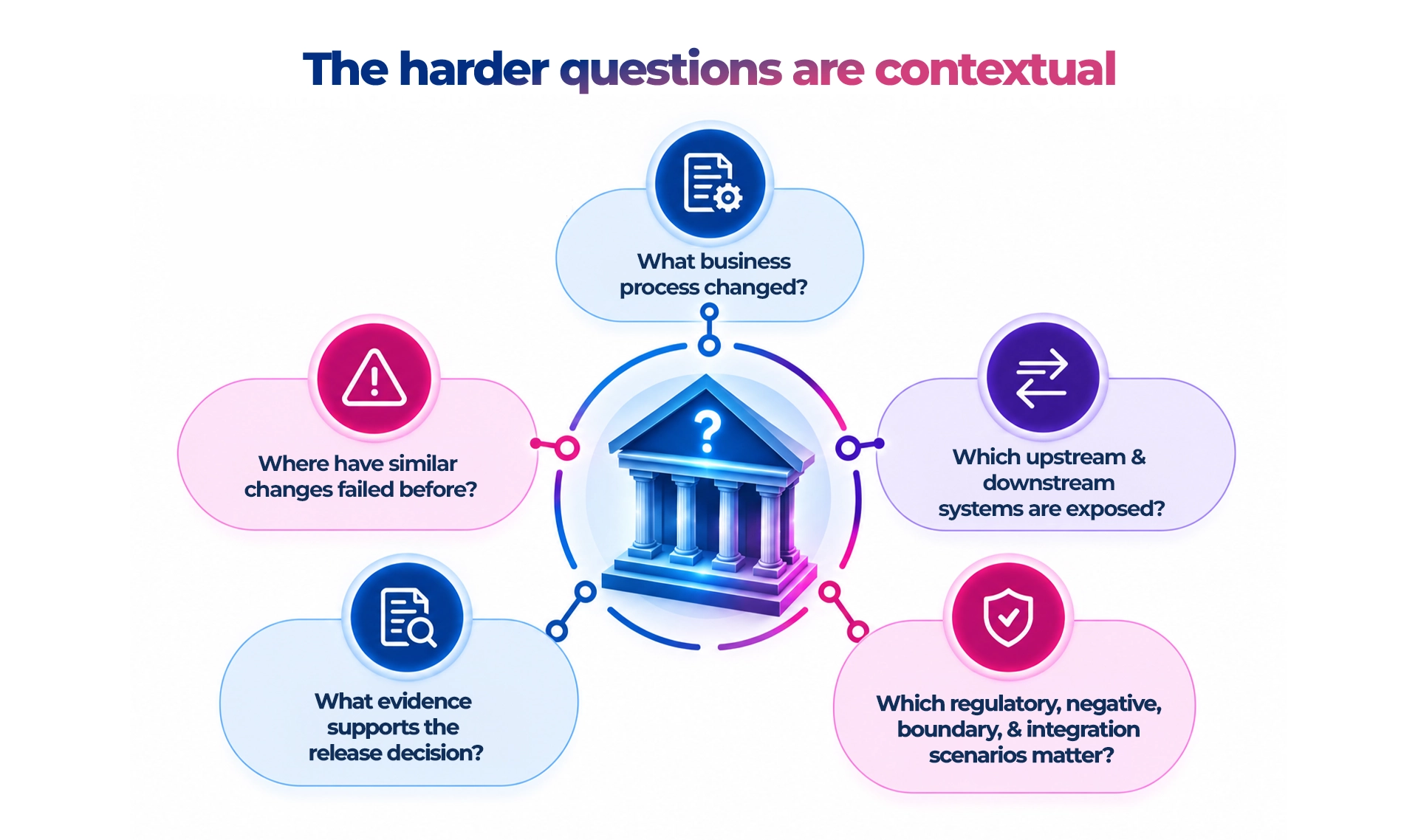
The harder questions are contextual:
- What business process changed?
- Which upstream and downstream systems are exposed?
- Where have similar changes failed before?
- Which regulatory, negative, boundary, and integration scenarios matter?
- What evidence supports the release decision?
Conventional automation does not answer these questions on its own. When coverage decisions rely on static regression packs or individual memory, higher development velocity can widen the gap between tests executed and risk understood.
The quality engineering model AI-first banking requires
Quality engineering in banking must evolve from a downstream validation phase into a continuous intelligence layer across the software development lifecycle.
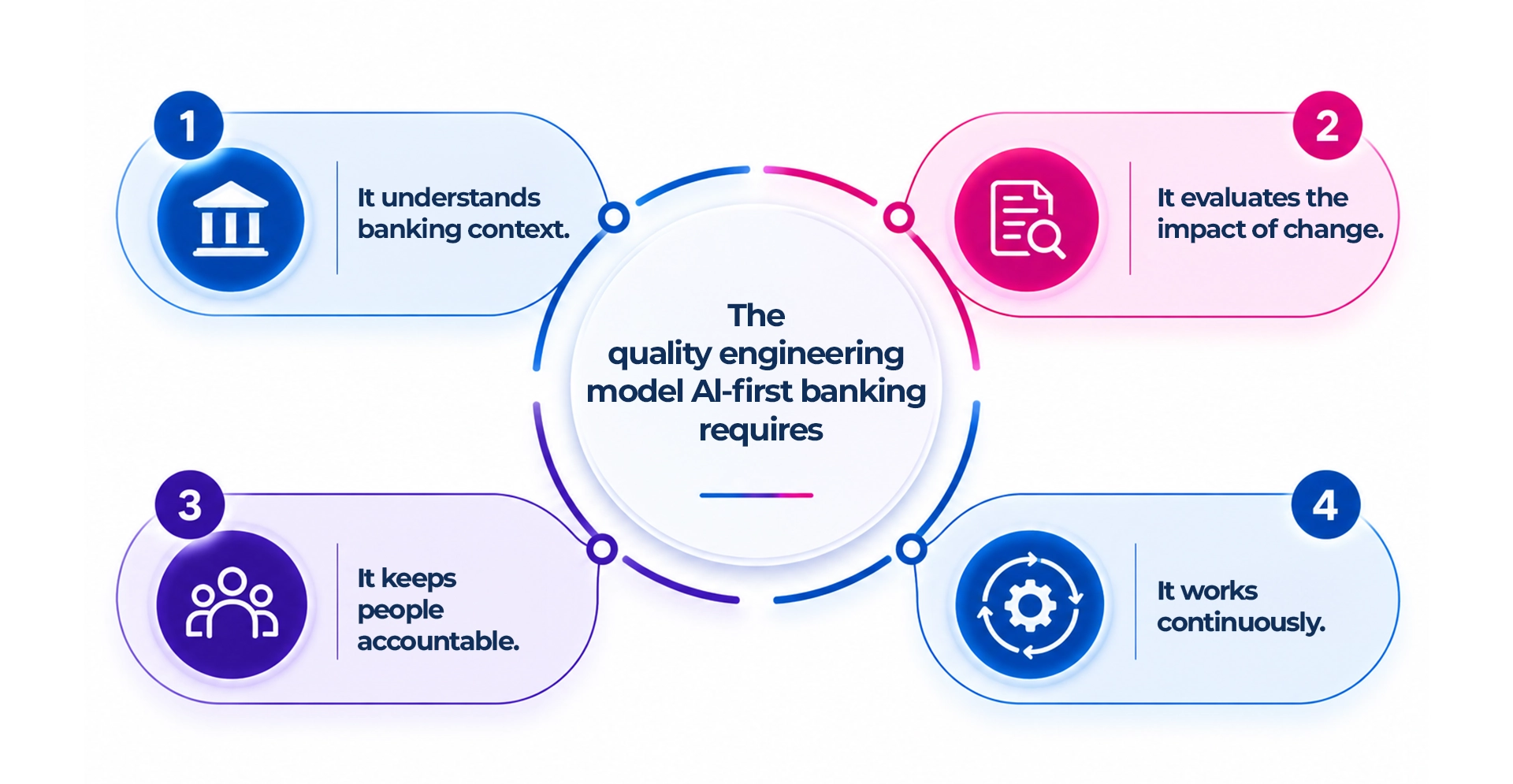
That model has four characteristics:
- It understands banking context. Requirements, business rules, test assets, process flows, dependencies, and defect history become connected knowledge rather than scattered documents.
- It evaluates the impact of change. Test scope is shaped by affected functions, integrations, and historical risk, not only by a prebuilt suite.
- It keeps people accountable. AI can propose scenarios, priorities, and test artifacts, while subject matter experts review, refine, and approve consequential outputs.
- It works continuously. Test design, automation, data, execution, reporting, and release evidence connect with existing delivery pipelines.
- This is the shift from faster testing to Continuous Quality Intelligence.
Where PULSEAI fits
Maveric PULSEAI is designed as a Continuous Quality Intelligence platform for banking. Its Knowledge Fabric brings together domain artifacts, business rules, test cases, dependencies, and defect lineage. Purpose-built quality engineering agents use that context to support story refinement, impact analysis, intelligent test design, risk-aligned regression, and automation-ready BDD outputs. Human review remains embedded in the workflow.
The value is not simply more generated test cases. It is a stronger connection between what changed, what matters to the bank, what needs to be tested, and why a release should be trusted.
For CIOs, the question is no longer whether AI can make development faster. It is whether the bank can convert that speed into dependable change.
What changes for the CIO and engineering leadership team
The response cannot sit solely with the testing function. AI-assisted delivery changes capacity planning, governance, architecture, and release management across technology. CIOs should expect quality leaders to participate earlier in portfolio and solution decisions, especially where a change affects high-value customer journeys or regulated processes.
Engineering leaders should also reconsider the metrics used to evaluate progress. Automation percentage and test-case counts describe activity. They do not show whether quality is keeping pace with development. More useful measures include the time required to assess change impact, the proportion of material risks linked to test evidence, the stability of automated assets, defect escape patterns, and the time between code completion and an informed release decision.
For regional banks, this can begin without an enterprise-wide redesign. A bank can select one recurring change journey, such as a lending product enhancement or digital onboarding release, connect the relevant requirements, tests, dependencies, and defect data, and compare the quality signal with its existing process. The purpose of the first implementation is to prove that better context produces a better decision.
A practical readiness test
Before accelerating AI adoption in software delivery, leaders should ask five questions:
- Can teams trace a change across the business processes and systems it affects?
- Can regression scope be explained using risk and evidence?
- Can generated test scenarios be traced to approved banking knowledge?
- Can specialists inspect and approve AI-supported outputs efficiently?
- Can quality evidence flow through current delivery and governance systems?
If the answer to several of these questions is no, the constraint is not the speed of the testing tool. It is the absence of a connected quality intelligence model. Addressing that foundation allows AI-enabled development and quality engineering to advance together.
See how PULSEAI brings measurable quality and trusted velocity to banking software delivery.
FAQ
1. How is AI changing software delivery in banking?
AI can accelerate requirements analysis, coding, documentation, testing, and defect triage. It also increases the volume and frequency of change, making contextual impact analysis and governed quality controls more important.
2. What is quality engineering in banking?
Quality engineering in banking embeds quality across the delivery lifecycle. It connects business requirements, regulatory expectations, application dependencies, test design, automation, execution, and release evidence.
3. Why is test automation alone insufficient for AI-first banking?
Automation speeds execution but does not automatically determine whether the right risks, processes, integrations, and edge cases are covered. That requires banking context and change intelligence.