

Banking software delivery has become too fast and interconnected for quality to depend on manual validation alone. Agile, DevOps, and AI-assisted development have compressed release cycles, while the systems underneath those releases still span products, business rules, integrations, and downstream applications.
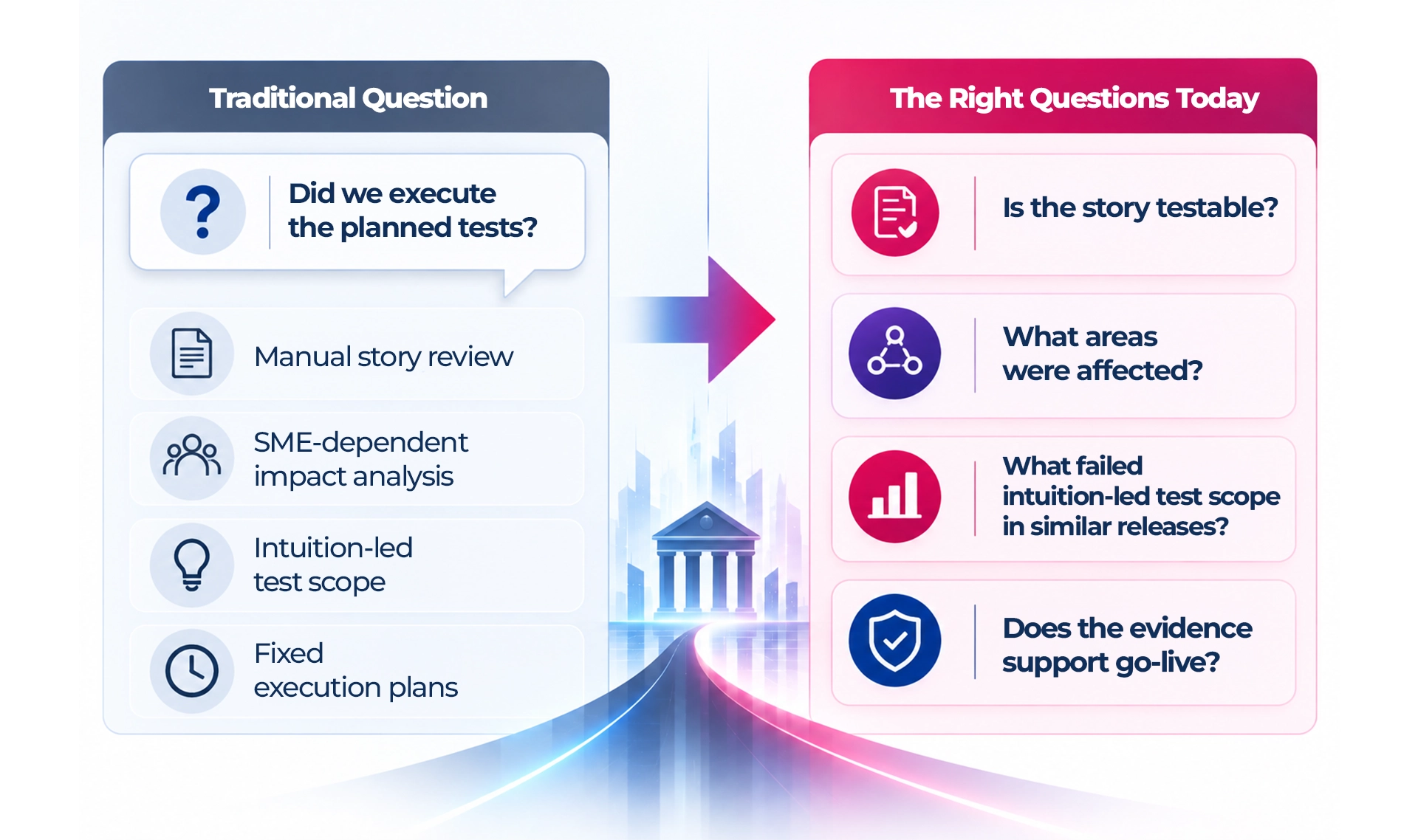
In that environment, the traditional question: “Did we execute the planned tests?”, is no longer enough. Teams also need to know whether the story was testable, which areas were affected, what failed in similar releases, and whether the evidence supports a confident go-live decision. That is the shift toward intelligent quality engineering: from validating what is already known to continuously understanding what matters.
Manual validation was built for a slower delivery model
Traditional quality processes place a great deal of responsibility on people to interpret change. User stories are reviewed manually. Impact analysis depends on SMEs. Test scope can be defined through experience and intuition. Scenario design may repeat across testing levels, while fixed execution plans can struggle when risk changes late in the cycle.
For software testing in banking, this creates a structural problem. Human expertise remains essential, but critical knowledge often sits across people, documents, test assets, defect histories, and business processes. When that context is not connected, gaps can become visible only after teams have moved downstream.
The same limitation appears in regression testing. A large regression pack may provide activity, but not necessarily relevance. Without clear dependency mapping and change-impact intelligence, teams can test too broadly in some places and not deeply enough in others.
The next step, therefore, is not to remove human judgment. It is to give that judgment a stronger, more systematic foundation.
Intelligence changes what quality engineering can understand
Intelligent quality engineering brings context into the testing lifecycle itself. In PULSEAI, AI-native knowledge management connects domain assets such as playbooks, prompts, telemetry, documents, test information, and defect history through a governed knowledge layer. A cognitive core uses that context to support understanding, generation, and prioritization across quality workflows.
This changes the role of automation. Rather than simply executing predefined scripts faster, automation becomes part of a larger intelligence-led process.
Requirements can be assessed for testability. Dependencies can be analyzed across systems. Test scope can be informed by impact. Scenarios can be expanded by risk. Historical defect patterns can influence planning before execution begins. QE agents can support scenario creation, test generation, and prioritization, while low-code capabilities help move designs toward executable automation.
As AI in banking increases the pace of software creation, this connected intelligence becomes increasingly important. The quality function must be able to preserve institutional knowledge and apply it consistently across the software testing lifecycle rather than repeatedly reconstructing context for every change.
The destination is explainable release confidence
The biggest change appears at the point of release. Traditional quality reporting is often driven by test counts, defect status, and completion metrics. These measures are useful, but they can become lagging indicators. They tell teams what happened without always explaining whether the most important risks were understood and covered.
Intelligent quality engineering shifts the focus toward decision-grade insights: risk-based prioritization, curated quality signals, early risk visibility, and evidence-backed readiness. In PULSEAI model, system-generated outputs are still reviewed, refined, and approved by relevant SMEs. Human accountability remains part of the workflow.
That is particularly important as it increases delivery speed. Banks do not simply need more automation; they need quality processes that can keep pace without losing context, traceability, or trust.
Conclusion
The shift from manual validation to intelligent quality engineering is not a story about replacing testers. It is about changing the quality function itself, from reactive checking to continuous, context-aware assurance. The goal is not merely to know that tests ran. It is to understand why the right tests were chosen, what risks they addressed, and whether the evidence is strong enough to support the release.
FAQ
1. What is intelligent quality engineering?
Intelligent quality engineering uses connected domain knowledge, system context, defect history, impact analysis, AI-assisted workflows, and automation to inform quality decisions throughout the software testing lifecycle rather than relying primarily on manual interpretation.
2. Why is manual validation becoming insufficient for modern banking systems?
Banking changes can affect multiple products, processes, applications, integrations, and downstream systems. Manual validation can struggle to consistently identify those dependencies, preserve institutional knowledge, and prioritize testing according to actual change impact.
3. How does intelligent quality engineering improve regression testing?
It helps teams move from intuition-led or static regression packs toward impact-informed, risk-based selection. Historical defects, system dependencies, business context, and change information can all contribute to deciding which scenarios deserve priority.
4. Does intelligent quality engineering replace testers and SMEs?
No. PULSEAI model retains human accountability. System-generated outputs are reviewed, refined, and approved by relevant experts before progressing. Intelligence supports human decision-making rather than removing it.
5. How does PULSEAI enable intelligent quality engineering?
PULSEAI brings together AI-native knowledge management, a cognitive core, QE agents and workflows, context-aware impact analysis, risk-based regression, low-code automation, continuous execution, and quality insights to support the journey from requirement assessment through release readiness.